Cannabis Tolerance Inside the Cell: A Room-Scale Map of CB1
What if a cell were the size of a room? A detailed map of CB1, and how cannabis tolerance is built and undone — from minutes of desensitization to weeks of recovery.
Quick Answer
THC tolerance is CB1 retuning, not a broken brain: receptors switch off in minutes, leave the membrane over hours, and are made in smaller numbers over days. After about four weeks of abstinence, cortical CB1 density returns to non-smoker levels.
Imagine scaling a single cell up a million times until it fills a room. You stand in the doorway and look inside — not through a microscope, and not at a textbook diagram, but into a space where you could walk between organelles the way you walk between machines on a factory floor.
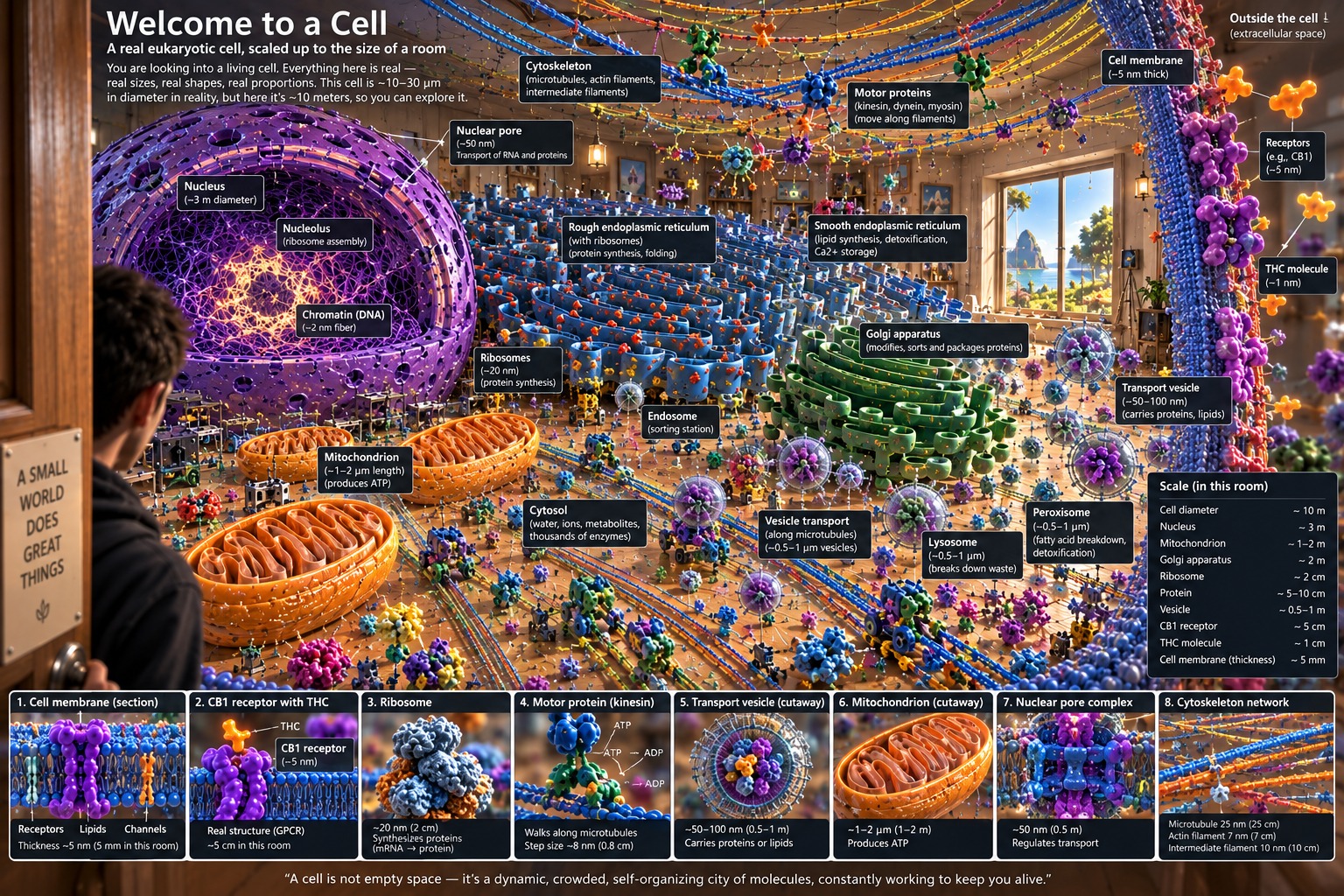
Open the image at full size: a click removes compression, and that is when the details become worth hunting for.
Why there is air instead of “water”
A real cell has no air. It is filled with cytosol — a dense broth of proteins, ions, and molecules. Draw it as it is and the picture collapses: shapes merge, distances vanish, scale disappears.
So the illustration replaces cytosol with air. It is not decoration. It is the only way to show what is usually hidden: how tightly a cell is packed, what organelles actually look like, and how far they sit from one another. The nucleus with its pores, the rough endoplasmic reticulum studded with ribosomes, the Golgi stack, mitochondria with cristae, microtubules along the “ceiling,” and kinesin walking a load along them — every object here has real geometry, not a blob.
The scale legend turns nanometers into centimeters of room:
-
cell (~10–30 µm) → a room about 10 meters across;
-
ribosome (~20 nm) → about 2 centimeters;
-
CB1 receptor (~5 nm) → about 5 centimeters, a door handle;
-
THC molecule (~1 nm) → about a centimeter, a bead.
Find CB1
Before going further, open the image at full size and try to find the CB1 receptor. Three landmarks:
- The right-hand “wall” is a slice of the cell membrane. Purple seven-helix proteins sit in it — GPCRs, including CB1.
- Nearby, small orange “tripods” are THC molecules settling into the binding pocket.
- At the bottom, inset #2 shows CB1 with THC in close-up — a cheat sheet if the overview is still too busy.
If you found it, the rest of the story gets easier. Tolerance is what happens when there are fewer of these handles on the membrane. That is not a breakdown. It is one of the most precise regulation systems in the body.
When it “doesn’t hit anymore”
The usual story is that the body got used to cannabis, blocked it, or broke something. At the cellular level something else is going on. The nervous system encodes change, not the absolute level of a signal. A receptor that is occupied all the time stops being informative — like a smell you stop noticing after ten minutes, or eyes adapting to bright light.
The endocannabinoid system is one of the oldest regulators in the brain. It does not exist for cannabis. It holds appetite, pain, mood, sleep, memory, and synaptic plasticity. THC enters this system as a foreign but similar key. The cell answers with the same mechanism it uses for any lingering signal through GPCR receptors.
The door handle on the membrane
CB1 — cannabinoid receptor type 1 — is a GPCR, a G-protein-coupled receptor. Seven helices span the lipid bilayer, which is why it looks like a snake on the picture. In the brain it is the most abundant receptor of this kind.
It sits mainly on presynaptic terminals — the “exit” of a neuron. When CB1 switches on through a Gi/o protein, it quiets adenylyl cyclase: less cAMP, less PKA. At the same time the βγ subunits open potassium GIRK channels and close N/P/Q calcium channels. Less calcium means less neurotransmitter released. For the synapse, that is a stop signal.
The body’s own endocannabinoids — anandamide and 2-AG — send this signal retrogradely: from the postsynapse backward, when activity is already too high. They live for seconds. THC is a partial agonist: it turns CB1 on, but not at full power, and because it is lipophilic it stays in the body for hours. An endocannabinoid is a pulse. THC is a key that sticks in the lock.
A pulse versus a stuck key
In a healthy system, anandamide and 2-AG are made from membrane lipids on demand, work for seconds, and are broken down by FAAH and MAGL. CB1 fires point by point: slow one synapse, then let go.
With regular THC the signal is not a pulse. It is almost continuous. The cell cannot simply turn off the light. It removes the switch. That happens in layers, from minutes to weeks.
Minutes to hours: the receptor is switched off in place
The first answer is fast and reversible. GRK phosphorylates the C-terminus of activated CB1. β-arrestin-2 binds there, and the receptor is physically off even if THC is still in the pocket. Like pulling a fuse: current is still in the wiring, the circuit is open. The same β-arrestin starts internalization: clathrin-mediated endocytosis pulls the receptor into the cell.
Hours to days: the handle comes off the wall
Inside the endosome a decision is made. CB1 can recycle back to the membrane — the fast path. Or it can go to the lysosome and be taken apart into amino acids. With chronic THC, more and more receptors move into intracellular stores. There are fewer on the surface — and that shows up not only in how a person feels, but on PET scans of the brain.
Days to weeks: the cell makes fewer new ones
If the signal never lets up, the cell goes deeper: less synthesis of new CB1, less delivery to the membrane, more breakdown of the old. A PET study by Hirvonen and colleagues (2012) found that daily smokers had about 20% lower CB1 density in cortex than controls. The longer the history of use, the stronger the shift.
Back to the room. Putting CB1 on the wall again takes a whole logistics line — one you can follow with your eyes on the picture:
- In the nucleus, the CB1 gene is transcribed into mRNA.
- Through a nuclear pore (inset #7) the mRNA leaves for the cytosol.
- On the rough ER, ribosomes (inset #3) build the protein.
- The Golgi packs, modifies, and sorts.
- A transport vesicle (inset #5) takes the load.
- Kinesin (inset #4) walks the microtubule (inset #8) toward the membrane.
- Exocytosis inserts the receptor into the lipid bilayer (inset #1).
The speed of this conveyor is the real answer to how long tolerance takes to ease. A protein does not appear on a click. It needs synthesis, delivery, and time to settle in the membrane.
Why the system is this elaborate
The endocannabinoid system exists in all vertebrates. It is about 500–600 million years old. GPCR desensitization and internalization are a universal move: opioid, adrenergic, and dopamine receptors do the same thing.
Tolerance is the price of a huge dynamic range. The brain has to encode a weak signal and a strong one equally well, so it keeps retuning sensitivity. At the cellular level it looks almost like engineering.
The crystal structure of CB1 (Hua et al., 2016, Cell) showed those seven helices and the binding pocket — the lock THC sits in. The shape of that pocket is why different cannabinoids behave differently, and why THC’s partial agonism gives it its particular profile.
Modern cannabis speeds the story up as well, because THC content has climbed from a few percent to the familiar twenty-plus — we wrote about that in the potency rise since the 1980s. Switching smoking methods barely “breaks” tolerance: at the same 0.5 g, a joint and a bong put the receptor into the same regime.
If you take a break
The first day or two
THC is still leaving fat tissue: it is lipophilic and stores itself in adipocytes. β-arrestin starts to let receptors go. In D'Souza et al. (2016), after two days of monitored abstinence the difference in CB1 availability between dependent users and controls was no longer statistically significant. Recovery starts quickly — faster than it feels.
Days 2–4
Irritability, insomnia, low appetite, sweats, anxiety. That is cannabis withdrawal: not a classic “crash,” but a system retuning after constant braking. The longer and more frequent the use, the clearer the symptoms (Budney et al.). The irony is that receptors are already coming back, while the brain has not caught the new balance yet.
Days 3–7
The most everyday marker is vivid, frequent, sometimes uneasy dreams. Endocannabinoids help shape sleep architecture; without constant THC, REM makes up for lost time.
Weeks 1–2
Recycling of CB1 to the membrane plus synthesis of new receptors. Sleep evens out, appetite returns, irritability eases.
Weeks 2–4
Hirvonen found that after about four weeks (26 ± 5 days) of observed abstinence, cortical CB1 density returns to non-smoker levels. That is the usual horizon for a real break.
The first dose afterward often hits harder than the body remembers: the receptors are fresh. Starting at half the usual amount is a safer guess.
Months 1–3
THC metabolites gradually leave fat. Working memory and reaction speed catch up — especially in younger people and in those who were not daily smokers for years.
Timelines stretch for people on chronic medical use, and for heavy daily use over ten years or more. A full zero is not mandatory. Lowering the dose, a calmer THC:CBD balance, and days off also give the system air — we wrote about that in the piece on “new sobriety”.
A room that is still working
THC tolerance is not lazy receptors and not a broken brain. It is several layers of cellular work: switching off in place within minutes, moving inward over hours, fewer handles on the wall over days — and a reverse synthesis line that, in two to four weeks of pause, puts CB1 back on the membrane.
Look at the picture again. The room is full of machines. Among them is a tiny CB1 door handle. Without it the system cannot do what evolution built it for: feel a change, not a constant background.
When it “doesn’t hit anymore,” the cell did not turn away. It did the thing it does best — it kept the ability to hear the next signal.
Educational material. CB1 density figures come from PET studies of daily smokers; individual timelines vary.
📚Sources & References
- 1Hirvonen J et al. Reversible CB1 downregulation in chronic daily cannabis smokers (2012)
- 2D'Souza DC et al. Rapid CB1 changes after cannabis abstinence (2016)
- 3Hua T et al. Crystal structure of human CB1 (Cell, 2016)
- 4Katona I & Freund TF. Endocannabinoid signaling (2012)
- 5Budney AJ et al. Cannabis withdrawal syndrome (2004)