Two hot knives, and the dab rig that grew out of them
A quartz bucket looks like a finished product. Nobody designed it in one sitting. From kitchen knives to a titanium skillet, a glass dome, and fused quartz.
Quick Answer
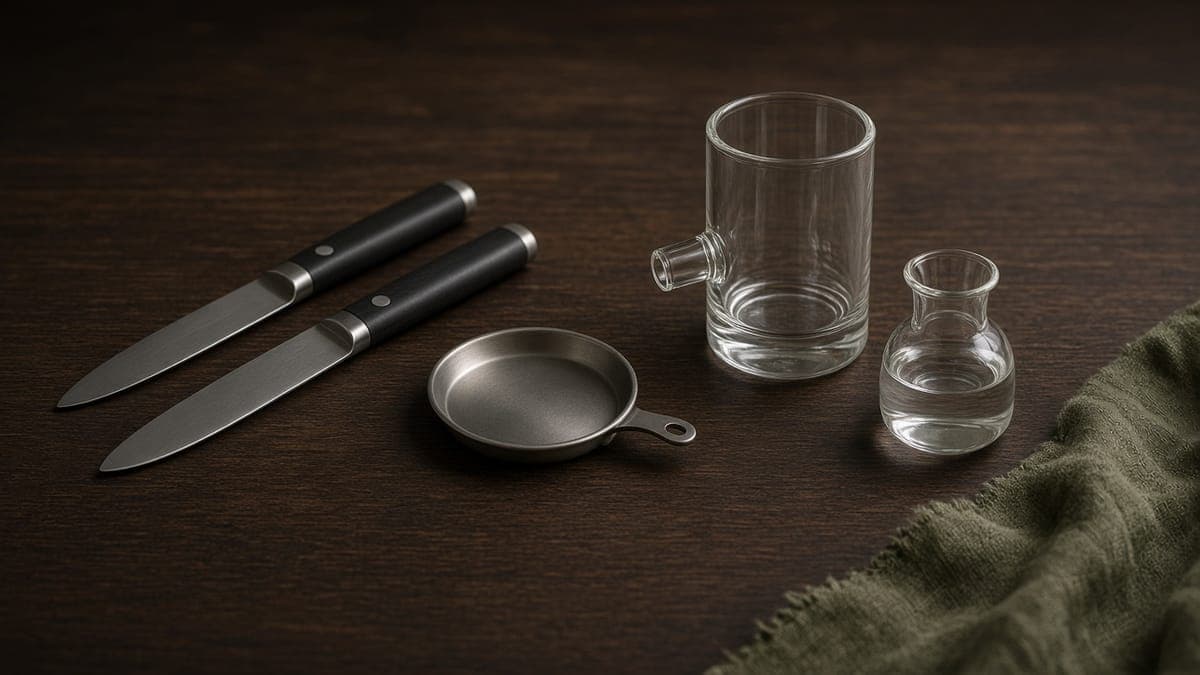
Nobody designed the modern dab rig in one sitting. In the 1960s–90s people heated concentrate on two kitchen knives: hot knives in the United States, Canada, and England, spotting in New Zealand. The HMK skillet comes together around 2006. JP Toro dates the dome to late 2006–2007; the Toro studio is in Dryden, New York. Quave built the Club Banger in Bellingham, and the shop is now in Seattle. The Nectar Collector was conceived in the Oregon woods in 2011; Kristian Merwin’s patent lists Salt Lake City, with priority on 21 December 2012.
A quartz bucket on a glass rig looks like someone designed the whole thing. Sat down, drew it, shipped 1.0.
Nobody did.
This story is close to the early personal computer: there was no single person who one day invented the modern dab rig. A handful of glassblowers and enthusiasts, mostly in the United States, spent about 10–15 years solving one engineering problem after another — how to vaporize a concentrate, how to catch the vapor, how to cool it, and how to control the temperature.
Where the dab came from
The principle is much older than the dab rig. Through the 1960s–90s, hot knifing was common: two metal knives were heated on a stove, hash or oil was placed between them, and the aerosol was inhaled through a tube or a bottle with the bottom cut off. Same idea: do not set the material on fire. Hand it heat from a hot surface, fast.
The spots article describes the same mechanic — two heated blades and a drop of oil — as a 1970s practice that spread across countries. In the United States, Canada, and England it was called hot knives. In New Zealand the same move settled under the name spotting, and that is still where it is most visible. The kitchen version that later grows into a rig is the one Weedmaps describes: a stove, two knives, a tube or a bottle with the base cut away.
Then someone had the obvious next thought.
Why not attach the hot knife to a bong?
2006: the skillet that swings
Around 2006 the glassblowers Hashmasta Kut (HMK) and his sister Lucy Carson, also known as GGirl, built what histories usually call one of the first real dab devices: the HMK Swing, also the Vapor Curve, also the Skillet. Weedmaps, The Dab Lab, and Gray Wolf's Lair describe the same machine. A current HMK rig on the shelf is sometimes labeled made in Canada — that is a label on a present-day piece at Aqua Lab, not a birth certificate for the 2006 skillet. The forum that made the piece famous was Toke City.
The device was literal:
hot knives → a small titanium skillet → a glass tube → water → mouth.
A titanium plate hung on a hinge. You swung it aside, heated it with a torch, swung it back under a glass bell, and laid the concentrate on it. Vapor was pulled into the glass.
This is the useful answer to “why glass, not metal?”: the heated part was metal. Titanium. Glass held the air and the water. The water piece was already a culture. The English word bong itself came from Thai บ้อง — we go into that in the long history of Samui. The industry did not have to invent the bong. It had to bolt a hot surface onto one.
Late 2000s: dome and nail
Next, the big swinging skillet shrank into a small nail, with a glass dome around it.
Authorship is disputed. One of the early glass nails is credited to a blower known as WBM.
The person usually credited with turning dome-and-nail into a system people could actually buy is JP Toro, founder of Toro Glass. In a Leaf Nation interview he dates titanium plus glass domes to late 2006–2007: shops thought he had lost it, and were afraid to sell the accessories. He talks about his youth this way: years in downtown Philadelphia, in a crew that drew comics. Gallery profiles place the Toro studio on the East Coast, in Dryden, New York, in the Finger Lakes — that is how Illuzion Glass Galleries tells it. The company was founded in 2006. Later the family describes New York as home and opens a dispensary in nearby Ithaca, Tompkins County, on their own founders page.
The recognizable rig is already here:
torch → nail → concentrate → dome → rig → water.
Then the dome became the extra part. Domeless titanium nails arrived. Task Rok and Highly Educated did a lot of that work. The company says it was founded on 10 July 2010.The Medical Jane directory places them in northern California. An old Stuff Stoners Like interview opens with “Salt Lake City’s Task Rok.” What Task says himself: the titanium is machined in the United States, and the domeless nail exists to delete the dome.
The bucket, and it is not glass
A good modern banger is usually not glass. It is fused quartz.
One of the main people here is the American glass artist the scene knows as Quave.A 2019 interview introduces him as Kevin McCulley. Shop bios sometimes print Quentin Wells. On the scene his name is Quave.
The Quartz Club Banger, QCB, from the early 2010s is one of the key ancestors of the modern quartz bucket. The brand says QCB was “forged in 2010.” A note in that same interview places the Club Banger in his Bellingham, Washington years, working with Scott Deppe at Mothership and developing the form on his own. Today the brand’s about page says bangers and carb caps are handmade in their Seattle shop.
In the Leaf Nation conversation, JP separately thanks Quave: the quartz banger brought a larger surface and a cleaner contact. Some reviews, including Hashwriter, give the earliest bucket silhouette to a blower known as Puking Beagle.Quave is the one whose quartz version people started copying.
The shape is not an accident. A wide flat floor lets the concentrate spread into a thin film. The walls hold thermal mass. Oil does not fall straight down the hole as easily. A cotton swab can reach the inside. A carb cap sits on top, cuts the airflow, and lets the oil vaporize at a lower temperature. Low-temp dabbing is what locked the geometry in. Highly Educated also lists the carb cap among its early ideas. The cap became necessary once the culture left red-hot heat behind.
The chain from there is short:
nail → quartz nail → quartz bucket → carb cap → pearls and inserts → the modern banger.
On the brand site in October 2026, core QCB models sit around $195–430. Angled versions start lower. Some charmers go higher. That is a shop window, not a revenue report.
Why quartz beat the metal that won first
Metal won first. Then it lost.
Titanium was mechanically excellent: it does not shatter, it heats fast, and you can machine a tough part out of it. That is why the old nails were mostly titanium.
Once the culture moved from “heat it until it glows” toward temperature and taste, quartz was simply more convenient. It is fairly inert, it does not lend a metallic surface note, it is transparent so you can see the concentrate, it cleans easily, and the bucket geometry can be tuned for heat and airflow.
The rig body stayed borosilicate glass, because American artistic glass pipes and bongs were already a culture. The combination is specific:
borosilicate rig + quartz banger + water + sometimes quartz pearls.
We wrote separately about what water does to the same 0.5 g: joint versus bong. Water cools. It does not erase what happens on the hot surface.
The Nectar Collector has signed inventors
This branch is documented better.
In 2011, in the backwoods of Oregon, Jeff Zobell — Jefe Z — was using ordinary laboratory glass pipettes as a straw: heat the tip, touch the concentrate. That summer he brought the idea to the glassblower Kristian Merwin. They made the Honey Badger straw. Merwin then added a vertical water chamber and kept the principle “the hot tip goes to the concentrate.” That is the Nectar Collector, in the brand’s own history.
Merwin’s company page says he lives in Salt Lake City, Utah. US patent US 9,445,628 B2, a handheld waterpipe with a spill-resistant chamber, lists him as the inventor and as a Salt Lake City resident. Priority is 21 December 2012, provisional application 61/740,683. The nonprovisional was filed on 20 December 2013. The patent was granted on 20 September 2016.
At the US Cannabis Cup in Seattle, in an interview Cannabis Cup published, the brand was then in Boulder, Colorado, and the pieces were made in Salt Lake City. The idea started in the Oregon woods. The inventor’s home, the patent, and the manufacture are in Utah. At that cup they named Boulder as the base.
The idea itself is a function inverted.
An ordinary dab: you carry the concentrate to the hot surface.
A Nectar Collector flips it: you carry the hot surface to the concentrate.
The separate tool in the middle stops being mandatory.
Did they get rich
Some of them turned a good part into a brand that is still alive. Nectar Collector still sells under that name. Merwin calls himself a glass artist and an entrepreneur, and the company traces itself to Merwin and Jefe. Quave turned the Club Banger into a premium line, and originals still sit on the shelf at hundreds of dollars, not tens.
This is a story of niche inventor-craftspeople, not a consumer-tech startup. The structural problem is that a successful banger geometry is extremely easy to copy. Once the bucket was obvious, the market filled with variations and cheap copies. Merwin’s patent covers a specific spill-resistant chamber, not the idea of a hot tip. A quartz bucket cannot be held by a patent.
The interesting part is the origin of the shape. A modern dab rig is a descendant of two hot kitchen knives.
hot knives → titanium skillet → dome and nail → domeless titanium nail → quartz banger + carb cap
The Nectar Collector is a side branch:
hot surface + concentrate → glass pipette → straw → water-cooled Nectar Collector
Nobody sat down and designed the system from a blank page. Each generation removed one annoyance of the previous one: the knives looked wild, the skillet was bulky, the dome was an extra part, titanium lied about taste, red heat burned the thing the concentrate was for.
📚Sources & References
- 1Weedmaps — What is a dab rig
- 2Wikipedia — Spots (cannabis)
- 3The Dab Lab — Dab tool origins
- 4Gray Wolf's Lair — HMK titanium skillet
- 5Aqua Lab — HMK rig, made in Canada label
- 6Leaf Nation — Q&A with JP Toro
- 7Illuzion Glass Galleries — Toro Glass, Dryden NY
- 8The Highly Connected — founders
- 9Highly Educated — about
- 10Medical Jane — Highly Educated, northern California
- 11The Artifacts Project — interview with Kevin McCulley (Quave), 2019
- 12Quave CB — about, Seattle shop
- 13Quave Club Bangers — current prices
- 14Hashwriter — quartz banger market
- 15Nectar Collector — about
- 16US patent 9,445,628 B2 — Kristian R. Merwin
- 17Cannabis Cup — Nectar Collector interview (Boulder / Salt Lake City)