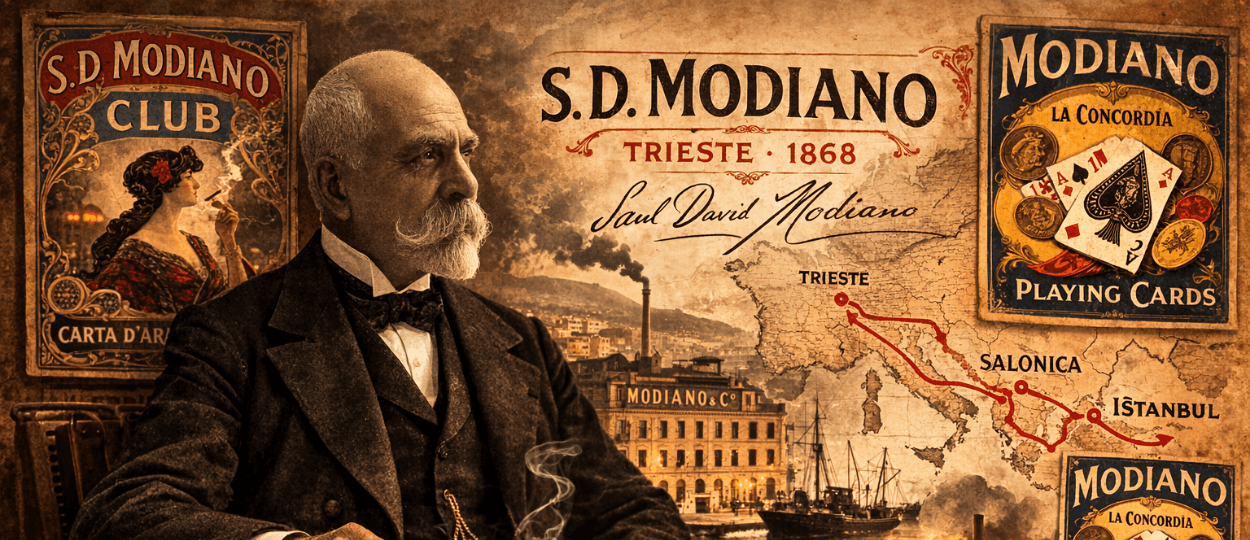
Saul Modiano Revolutionized Rolling Papers and Playing Cards Across Europe
Saul Modiano, a Sephardic Jewish entrepreneur, built a pioneering rolling paper and playing card empire, introducing innovations that still influence European smoking and gaming culture today
Key Points
- 1Saul Modiano founded a rolling paper and playing card empire spanning Europe and the Mediterranean
- 2He introduced the pop-up interleaved rolling paper booklet before Zig-Zag's famed patent
- 3Modiano's company expanded into lithography, design, glassmaking, and more, employing over 1,000 workers
- 4His legacy endures through Modiano playing cards, still sold worldwide
- 5OG Lab notes Modiano's innovations continue to shape cannabis and gaming accessories markets
Long before modern rolling paper brands dominated the market, Saul David Modiano, a Sephardic Jewish merchant from the Ottoman Empire, transformed the landscape of smoking accessories and playing cards throughout Europe and the Mediterranean. Born around 1840 in Salonica (now Thessaloniki, Greece), Modiano was part of a prominent merchant family whose roots traced back to Jews expelled from Spain in the 1490s. This heritage connected him to a vast Mediterranean trading network and shaped his entrepreneurial journey
Modiano's move to Trieste, a bustling Adriatic port in the Austro-Hungarian Empire, marked the beginning of his business legacy. He opened his first shop in 1868, selling imported rolling papers to meet surging demand. By 1873, he was manufacturing his own slow-burning, smooth papers in visually striking, lithographed packets, quickly rivaling and eventually surpassing dominant French brands. His products became household staples from royal courts to dockworkers, with the Modiano name recognized across the Ottoman Empire, North Africa, and the Balkans
According to rolling-paper historian Anton Mark Nelson, Modiano was a pioneer in rolling paper innovation, potentially beating the famed Zig-Zag brand to the pop-up interleaved booklet format. "Modiano was already selling interleaved booklets by 1893 under the name CLUB in Trieste, before the Braunstein brothers made the system famous through Zig-Zag’s later patent-era legend," Nelson explained. Modiano patented the CLUB booklet in 1894, the same year as the Zig-Zag patent, solidifying his reputation as an innovator in the industry
Modiano's influence extended beyond rolling papers. By the 1880s, he had expanded into lithography, box-making, and graphic design, culminating in the acquisition of the historic La Concordia playing card factory in 1884. He employed renowned Italian illustrators like Marcello Dudovich and Luigi Cambon, producing posters and decks that became cultural icons across Europe. At its height in the early 20th century, the Modiano company operated factories in multiple cities and employed over 1,000 workers, with families dedicating generations to his enterprise
His entrepreneurial pursuits also included ventures into glassmaking, cement, and early automotive and electrical industries. Despite political challenges, particularly during World War I when his factory was burned amid rising tensions, Modiano continued to innovate and rebuild. After his death, his son Ettore continued the family tradition, even establishing a retirement home for elderly Jews in Thessaloniki in Saul's honor. The Modiano brand remained family-run until 1987 and continues to be recognized today through its playing cards, cherished by poker players and magicians alike
From the OG Lab newsroom perspective, Saul Modiano's story exemplifies how a single visionary can leave a lasting mark on both cannabis culture and European industry. His innovations in rolling papers and playing cards set standards still relevant today, demonstrating the enduring impact of design and entrepreneurship. As the cannabis accessories market continues to evolve globally, Modiano’s legacy serves as a reminder of the power of heritage, adaptation, and creative thinking in shaping consumer habits