The Hidden History of Koh Samui: Fishermen, Bamboo Bongs, and the Doctor Who Built an Airport
Most people know Koh Samui as a beach paradise. Few know it was roadless until the 1970s, housed a Japanese wartime base, gave the English language the word "bong," and owes its airport to a surgeon who sold everything he owned to build a runway on a coconut plantation. This is the story of Thailand's most layered island — two thousand years in the making.
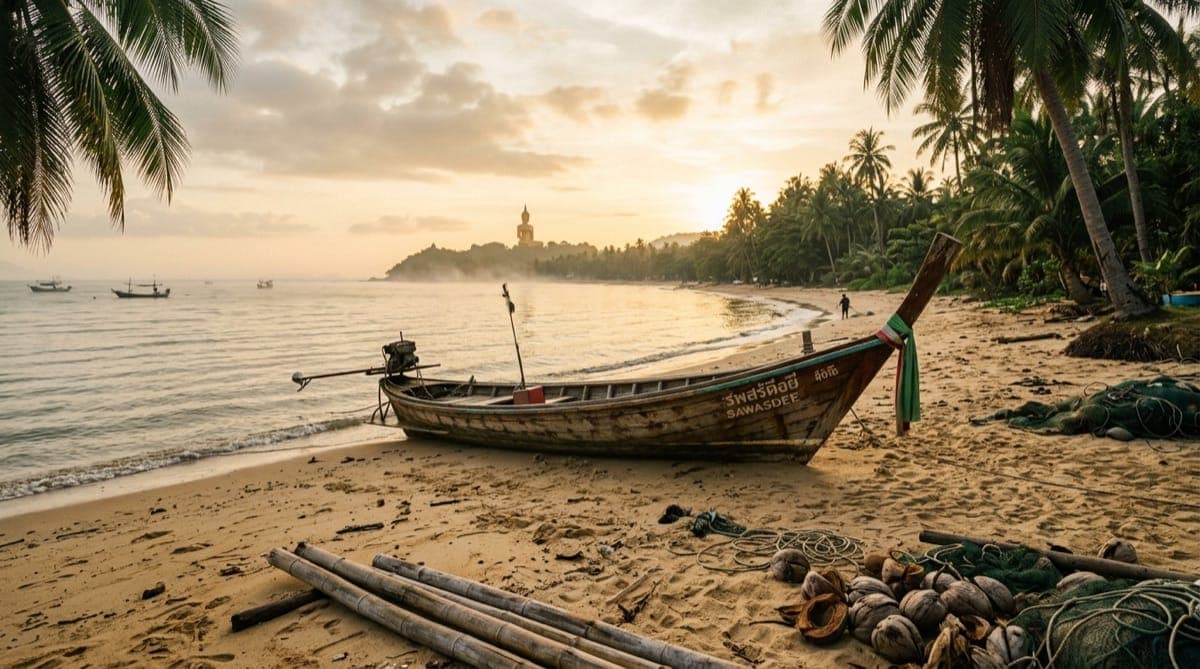
When your plane descends toward Samui, the first thing you see is a green thumbprint in the Gulf of Thailand, ringed by a white hem of sand. The airport itself is open-air — thatched roofs, tropical gardens, warm humid air hitting you the moment you step off the jet bridge. It feels like the island has always been this way: relaxed, beautiful, purpose-built for leisure.
It hasn't. The story of Koh Samui is one of profound isolation, jungle treks to reach the next village, Hainanese merchants who crossed an ocean and planted coconut groves that would define an economy for a century, a World War II explosion that locals still whisper about, a Buddhist monk whose mummified body wears Ray-Bans, and one stubborn surgeon who gambled his fortune on a runway.
An island without roads
Oral tradition and archaeological evidence suggest Samui was first settled around the sixth century AD, though recent finds push human habitation back over two thousand years. The earliest inhabitants were fishermen from the Malay Peninsula and seafarers from Southern China, using the island as a storm-season refuge — a safe harbour in the middle of the Gulf.
The island appears on Chinese Ming Dynasty maps from 1687 under the name Pulo Cornam. The meaning of "Samui" itself remains disputed: it may derive from mui (ต้นสมุย), a native tree; from a Sanskrit-Tamil word สมวย meaning "sea weather"; or from the Hainanese Chinese เซ่าบ่วย — "first island," "gateway," or literally "beautiful beach." For Hainanese sailors heading into Siam, Samui was indeed the first landfall.
From the thirteenth century onward, the island was part of the Siamese feudal system, linked to the mainland city-state of Nakhon Si Thammarat and positioned on the maritime route between China and India. Yet despite that strategic location, Samui remained astonishingly cut off: as late as the 1960s, travelling 15 kilometres from one village to another meant a full day's hike through mountainous jungle, with an overnight stay at the other end.
The Hainanese: people who brought a whole world with them
During the nineteenth century — particularly under Kings Rama III (1824–1851) and Rama V — Siam opened trade routes with China. Hainanese Chinese, from China's southernmost island province, migrated to Thailand in large numbers. Many settled on Koh Samui: the rhythms of island life reminded them of home.
Unlike the Philippines or Indonesia, where Chinese migrants were met with violence, Siam's Buddhist communities welcomed the newcomers. The Hainanese brought cotton, porcelain, silk, Chinese rum, pig farming, and their architecture. Most importantly, they established the coconut plantations that would become the island's economic backbone for the next century and a half.
Coconut Island — that was Samui's nickname. Plantations covered most of the territory, and copra was shipped to the mainland on traditional boats called panuk lang si (ปะนุกลังสี). Hainanese families settled closer to the coast, while ethnic Thais lived deeper in the jungle. The old quarters of Nathon — the island's administrative centre — still show traces of Sino-Thai architecture: wooden shopfronts and narrow alleys.
The Guan Yu Shrine and a living heritage
In 1857 (some sources say 1872), Hainanese community leaders on Samui erected a small wooden shrine in Ban Na Khai village, dedicated to Guan Yu — the legendary Three Kingdoms general who became a god of war, loyalty, and prosperity. In 1935 it was moved to Hua Thanon market. In 2008 construction began on a grand new complex featuring a 16-metre bronze Guan Yu statue — the tallest in Thailand — funded entirely by donations from descendants of Hainanese migrants.
Fah Thai Magazine, the in-flight publication of Bangkok Airways, documents rare Hainanese rituals still practised on Samui: tiger dances, fire-walking (participants walk barefoot over smouldering embers carrying sacred images — a purification rite held once every five to ten years), and the Jian Biao ceremony (a petition to heaven). This is living heritage that is becoming increasingly rare even in China itself.
Four Hainanese shrines stand on Samui today. Most are dedicated to Jao Mae Tubtim, goddess of the sea. As the Hainanese saying goes: "Wherever there are Hainanese, there is a Jao Mae Tubtim shrine."
Monkeys and coconuts: a tradition born from compassion
One of Samui's most distinctive traditions is the use of monkeys to harvest coconuts. Pig-tailed macaques (Macaca nemestrina), called ling klang in Thai, can pick 500–1,000 coconuts a day — compared with 80–100 for a human.
But behind this practice lies Buddhist philosophy, not mere economics. In 1957, a farmer named Somporn Saekhow from nearby Surat Thani province founded Thailand's first monkey training school. His parents owned a coconut plantation, and he watched owners beat their animals for leaving ripe coconuts on the tree. His Buddhist teacher — the renowned monk Buddhadasa of Wat Suan Mokkh in Chaiya — encouraged him to train monkeys through positive reinforcement, without violence.
Training took about six months: first the macaque learned to trust humans, then it was shown how to twist a coconut, then the coconut was mounted on a pole, then on a tree. Somporn's school became the largest in southern Thailand. In 1993 his favourite monkey, Khai Nui, carried the provincial flag at the National Games opening ceremony. Somporn died of a heart attack in 2002 — right after a demonstration for tourists. His daughter Somjai continues the school.
World War II: the explosion nobody talks about
Few tourists swimming off Taling Ngam beach on Samui's southwest coast notice the rusting hull of a sunken Japanese tanker poking out of the water.
During World War II, Koh Samui served as a Japanese naval base under the Japan-Thailand alliance. On 15 June 1945, according to historian Paul Chambers, Allied forces bombed a Japanese tanker off the island's coast. In 2025, Smithsonian Magazine published an investigation into the incident — and acknowledged that none of the more than twenty World War II experts consulted could fully untangle the story.
Jongkol Ormzubsin, 86 at the time of the interview, told the Smithsonian how she hid in a cave with her siblings for three days as a child, surviving on rice balls while a mushroom cloud rose over the sea. It is a dark page in the history of a quiet island — one that locals rarely discuss.
The monk in sunglasses
In 1973, a monk named Luang Pho Daeng died in the lotus position at Wat Khunaram temple on Samui. He was 79. Before death, he asked: if his body were to remain intact, it should be displayed in a glass coffin as a reminder of impermanence.
The body remained intact. In 2002, researchers from the Bioanthropology Research Institute X-rayed the mummy and found that internal organs were still in place — shrunken from dehydration but not decomposed. Geckos, however, had laid eggs in the mouth, throat, and skull. The eyes had decayed, so local monks placed sunglasses over the sockets to avoid frightening children. National Geographic confirmed: it is a real body, not a wax figure.
Today, Wat Khunaram is one of Samui's most visited sites. Admission is free. Luang Pho Daeng, born on the island in 1894, became a monk only at 50, after raising his children. He was a master of vipassana meditation and reportedly could go 15 days without food or water.
The road they spent six years building
In 1967, village headman Khun Dilok Suthiklom decided Samui needed roads. He petitioned the government for funding to build a ring road around the island — the very Route 4169 that every tourist drives today.
The task was monumental. Cliffs between Bang Po and Nathon, rocky slopes around Lamai — everything had to be blasted with dynamite and cleared by hand. Heavy machinery had to be shipped to the island by sea. Monsoons repeatedly delayed construction. It took from 1969 to 1973 to lay 50 kilometres of concrete slabs, initially just two metres wide. For the first time, you could drive around the island — though passengers sometimes had to get out and push.
That same year, 1972, on a tiny islet called Ko Faan off the northeast coast, connected to Samui by a causeway, monks completed Wat Phra Yai — the Big Buddha Temple with its 12-metre golden statue. Community leaders envisioned it as a spiritual anchor for an island that was already beginning to change.
Coconut boats and backpackers
In the late 1970s, the first Western travellers began arriving. The road existed, but no airport. The only way in was by sea: a six-hour overnight crossing from Surat Thani on cargo vessels called "coconut boats" — the same ships that carried copra to the mainland.
One of the earliest backpackers to publish his memories described Samui like this: "In front of us was this beautiful island — a typical tropical one, with a small village and dock, sandy beaches fringed by coconut palms. The ship was too big to come closer, so we were ferried ashore in a small boat." A bungalow room cost 15 baht a night. Pad thai — 6 baht. Coca-Cola — 1 baht.
There were no roads into the interior: travellers rode on locals' motorbikes through jungle trails. They visited waterfalls, watched trained monkeys harvest coconuts, went fishing with Thai villagers near the neighbouring islands — including Koh Phangan, which was virtually uninhabited at the time.
Word about the paradise island spread along the backpacker trail, and by the mid-1980s Samui was on the map.
But the backpackers took home more than memories of beaches. They took a word.
Bamboo, water, and a word the whole world knows
Here is a fact that surprises most people: the English word bong is Thai. Not slang, not jargon — a direct borrowing from the Thai language: บ้อง (baung), meaning "cylindrical bamboo tube." It is documented as early as the McFarland Thai-English Dictionary of 1944: "a bamboo waterpipe for smoking kancha, tree, hashish, or the hemp-plant."
For centuries, Thai farmers and fishermen used bamboo water pipes as part of everyday life. Cannabis — kancha (กัญชา), a word cognate with the Sanskrit ganja — was legal in Siam until 1934. It was added to kuay tiew rua (boat noodle soup) as a seasoning, featured in over 200 recorded traditional medicine formulas, and served as an analgesic and sedative. Muay Thai fighters wrapped their hands in hemp fibre before bouts — until the switch to Western boxing gloves in the 1920s. The Hmong people in northern Thailand had used hemp as a textile fibre for clothing for centuries.
The bamboo bong — baung — was a natural extension of this culture. Bamboo grew everywhere, water filtered and cooled the smoke, and the natural node of a bamboo stalk formed a ready-made water chamber. Simple, brilliant folk engineering.
Why the islands mattered
Koh Samui and the neighbouring Gulf islands — Koh Phangan, Koh Tao — remained isolated longer than mainland Thailand. Traditions persisted here in purer form: no urban modernisation, no American military bases (those were on the mainland — in Udon Thani, Korat, U-Tapao). When 1970s backpackers arrived on coconut boats, they stepped into a world where a bamboo water pipe was as ordinary a household object as a kerosene lamp or a fishing net.
It was through these travellers — and through Vietnam War veterans on R&R in Thailand — that the Thai word baung entered English as bong and became a global term. The first known Western print reference dates to January 1971 (Marijuana Review). By the late 1970s, the word was in common use on both sides of the Atlantic.
Thai Stick: born in Isan, famed on the islands
Alongside the bong, another Thai legend went global — Thai Stick. These were premium landrace sativa buds from the northeastern Isan region, skewered on bamboo sticks, bound with hemp fibre, treated with hash oil, and cured underground. An artisanal product that cost $3 per kilogram at the farm and sold for $4,000 in any American city.
According to The Diplomat, roughly a thousand tonnes of Thai Stick were shipped out of the country between 1968 and 1972. Historians Peter Maguire and Mike Ritter, in Thai Stick: Surfers, Scammers, and the Untold Story of the Marijuana Trade (Columbia University Press, 2013), documented how surfers, hippies, and ex-military turned a cottage industry into one of history's most lucrative smuggling operations. Routes ran through Bangkok, Pattaya, and — inevitably — the Gulf islands, including Samui.
Those same coconut boats that carried copra to the mainland and backpackers to the island were part of the ecosystem. Not every passenger was carrying just a backpack.
By the late 1970s, the Thai government — funded by the United States — launched its war on drugs. Farmers were paid to burn their crops and switch to coffee. Thai Stick vanished. Cannabis was criminalised under the 1979 Narcotics Act — and stayed in the shadows for nearly half a century.
The return: 2022 and a new era
In June 2022, Thailand became the first country in Asia to decriminalise cannabis. The plant was removed from the narcotics list. 4,200 prisoners were released. Health Minister Anutin Charnvirakul promised a million free seedlings for the public.
On Samui, the effect was instant. Dispensaries and weed shops opened along Chaweng and Lamai; cannabis lounges became part of the resort landscape. The Daily Mail called the island "the new Amsterdam." And when HBO filmed The White Lotus Season 3 on Samui, the Magical Weed Garden Lounge — a real cannabis lounge on the island — appeared on screen.
The circle closed: the island from which 1970s backpackers carried the word bong into the global lexicon was once again a place where cannabis is a legal part of the cultural landscape. Only now bamboo pipes have given way to glass, and coconut boats to Bangkok Airways jets.
For a deeper look at how cannabis tourism works around the world — and why some nationalities buy freely while others are afraid to even walk into a shop — we wrote a separate piece on that. And for the science behind what actually determines cannabis quality, see our lab investigation.
The doctor who built an airport
Prasert Prasarttong-Osoth was a surgeon who fell in love with aviation as a boy, watching World War II bombers fly overhead. In 1968 he founded Sahakol Air as a charter service. By the 1980s he realised Samui could become an international resort — but only if it had an airport.
The government was not interested. Investment bankers told him the island could sustain two weekly flights at best. So Prasert sold his assets — including the land under his office — and invested roughly 800 million baht ($38 million) in building an airfield on a former coconut plantation near Bophut beach.
Construction began around 1982–1984. When the airport was ready, the government — perhaps protecting flag carrier Thai Airways — declared it unsafe. For months, Prasert's investment sat idle. Only after an ICAO inspection gave its seal of approval did the government relent.
On 25 April 1989, Samui Airport officially opened — Thailand's first privately owned international airport. The inaugural Bangkok Airways flight was a 37-seat Dash 8-100. Today the airport handles over a million passengers a year, and Samui routes account for 50% of Bangkok Airways' passenger revenue.
The airport still belongs to Bangkok Airways and retains its distinctive architecture: open-air terminals, thatched roofs, tropical gardens. Bangkok Post called Prasert "a true aviation pioneer."
Boom, concrete, and balance
The 1990s and 2000s brought rapid development: luxury hotels, dive centres, shopping malls, two international hospitals. Chaweng and Lamai went from fishing villages to resort strips. Coconut plantations gave way to hotels. The municipality of Koh Samui — population around 70,000 — received city self-governance status.
But the island did not lose itself. Fisherman's Village in Bophut kept its wooden shopfronts and narrow lanes — a living museum of Sino-Malay architecture. Hua Thanon, one of the oldest settlements, remains a Muslim fishing community with a dawn fish market. The Secret Buddha Garden, created in the 1970s by a local farmer named Khun Nim in the central highlands, still hides in the jungle. And monasteries, shrines, and the annual Vegetarian Festival (Jiu Huang Ye) continue to set the rhythm of local life.
The White Lotus and the next turn
In 2025, HBO released Season 3 of The White Lotus, filmed at Four Seasons Resort Koh Samui. The impact was immediate: search queries for Samui surged 88%, hotel bookings rose 44%, and average nightly rates jumped 10–50%. The vice president of the Tourism Council of Thailand declared that for the first time in history, Samui might have no low season. Thailand is targeting 40 million international tourists in 2025, and Samui is at the tip of that wave.
But The White Lotus showed more than a resort. The series featured trained snakes, the Full Moon Party on neighbouring Koh Phangan, and the cannabis lounge we mentioned above. This is no longer the backpacker Samui of the 1970s or the coconut island of the nineteenth century. This is an island that went from total isolation to global cultural brand in a single generation.
What lies beneath the surface
Most visitors see Samui as "a resort with palm trees." But beneath the surface are layers invisible from a sun lounger.
Buddhist monasteries and Hainanese shrines coexist side by side, alongside a Muslim fishing village in Hua Thanon and a Chinese cultural centre, a mummified monk in sunglasses and cannabis dispensaries on Chaweng. An island that sent the word bong into the global lexicon and gave the world the legendary Thai Stick now welcomes over a million tourists a year through a private airport built by one determined surgeon.
We live and work on Samui, and we see these layers every day. If you visit — look beyond the beaches. Walk to Hua Thanon and the Guan Yu shrine, sit at the fish market at dawn, climb up to the Secret Buddha Garden. Listen to what the island sounds like when the tourist noise fades. Samui has character — and it was shaped not by hoteliers, but by fishermen, monks, merchants, and one doctor with a dream of a runway.
Stay up to date with the latest news on island life and the industry.
This article is for informational purposes, based on published research, archival interviews, and historical sources.
Quick Answer
Koh Samui was settled around 2,000 years ago by Malay fishermen. Hainanese Chinese established coconut plantations in the 19th century. The island had no roads until the 1970s. The English word "bong" comes from Thai บ้อง (baung), a bamboo water pipe — carried into English by 1970s backpackers. In 1989 a surgeon built a private airport, and in 2025 HBO''s White Lotus boosted search queries by 88%.
📚Sources & References
- 1Smithsonian Magazine — The Secret World War II History of Koh Samui
- 2Fah Thai Magazine (Bangkok Airways) — Where the Gods Came Ashore: Hainanese Heritage on Koh Samui
- 3Wikipedia — Ko Samui (sources, maps, archaeological evidence)
- 4Camille's Samui Info — Construction of the Ring Road Around Koh Samui 1969–1970
- 5Stickman Bangkok — Ko Samui in the 70s (firsthand backpacker account)
- 6FlightGlobal — Regional Thai: Bangkok Airways & Samui Airport history
- 7Bangkok Post — A True Aviation Pioneer: Prasert Prasarttong-Osoth
- 8Wikipedia — Samui Airport
- 9Wikipedia — Somporn Saekhow (founder of monkey training school)
- 10Wikipedia — Luang Pho Daeng (mummified monk of Wat Khunaram)
- 11CNBC — White Lotus Effect: Koh Samui searches and prices surge
- 12Bangkok Post — The White Lotus sparks tourism boom in Koh Samui
- 13Etymology Online — Bong: from Thai baung, cylindrical wooden tube
- 14Wikipedia — Bong (etymology, McFarland Thai-English Dictionary 1944)
- 15ThaiLawForum — History of Cannabis Use and Anti-Marijuana Laws in Thailand
- 16Leafie — The History of Thai Stick: the most misunderstood story in cannabis
- 17Peter Maguire, Mike Ritter — Thai Stick: Surfers, Scammers, and the Untold Story of the Marijuana Trade (Columbia UP, 2013)
- 18Wikipedia — Cannabis in Thailand
- 19Daily Mail — Koh Samui: the new Amsterdam (cannabis tourism, 2022)
- 20ThaiBong.com — The Thai Bong: A Cultural Journey from Bamboo to Teak