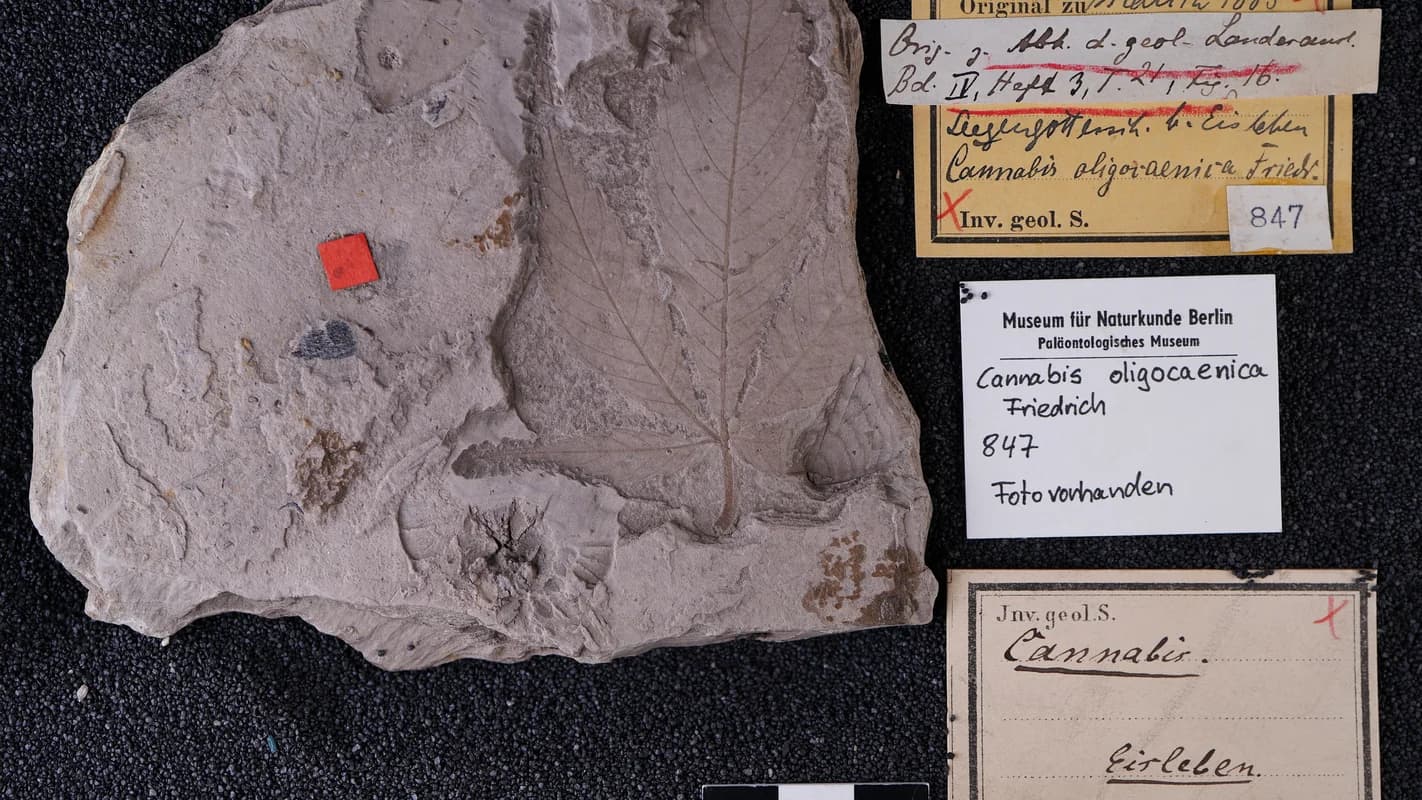
Berlin Museum Scientists Identify Potential 56-Million-Year-Old Cannabis Fossil
Scientists at Berlin’s Museum für Naturkunde have identified a fossilized leaf that may be the world’s oldest cannabis specimen, potentially doubling the accepted timeline for the Cannabis genus and challenging its known origins
Key Points
- 1A 56-million-year-old fossilized leaf found in Germany may be the oldest known cannabis specimen
- 2The fossil was first described in 1883 but only recently analyzed in detail by researchers
- 3The leaf’s morphology closely resembles modern cannabis, though microscopic trichomes are missing, preventing definitive classification
- 4If confirmed, the discovery could challenge current theories that trace cannabis origins to Central Asia
- 5Further investigations are underway at Berlin’s Museum für Naturkunde to validate the fossil’s identity
A fossilized leaf imprint unearthed near Eisleben, Germany, and housed at Berlin’s Museum für Naturkunde may represent the oldest known cannabis specimen ever discovered, according to recent research. Scientists believe the fossil dates back to the Lower Eocene epoch, approximately 56 million years ago, which could double the previously accepted age for the Cannabis genus. If confirmed, this find would not only reshape the botanical history of the plant but also challenge longstanding theories regarding its geographic origins
Originally described in 1883 as Cannabis oligocaenica by scientist Paul Friedrich, the fossil had remained largely overlooked in the museum’s collection for nearly 140 years. It was only after a recent re-examination that researchers realized the specimen’s potential significance. The leaf impression, preserved in fossilized mud, shares a striking morphological resemblance to modern cannabis plants, particularly in the shape and venation of its leaves
Ludwig Luthardt, a researcher at the Museum für Naturkunde Berlin, emphasized the similarities: “The morphological similarities with modern-day cannabis leaves is striking. Not only the overall morphology or outlines of the leaves is nearly identical but also the leaf venation pattern.” However, the fossil lacks the microscopic trichomes—hair-like structures on cannabis leaves that contain THC—making definitive classification within the Cannabis genus challenging. As the museum noted in a press release, “Further investigations are now underway to determine whether this is indeed by far the oldest known specimen of the Cannabis genus.”
This discovery could upend the widely held belief that cannabis originated in Central Asia, particularly the Tibetan Plateau and northwest China. Previous evidence, such as Miocene-era pollen samples and molecular dating of modern plant DNA, placed the genus at 20 to 28 million years old and traced its roots to that region. The German fossil, however, suggests a much older and potentially more geographically diverse history for cannabis and its relatives in the Cannabaceae family
Researchers caution that the 56-million-year timeline remains preliminary until further analysis is complete. Still, the find opens new lines of inquiry about the plant’s evolutionary adaptations, historical range, and even the earliest interactions between cannabis and humans. Luthardt speculated that even older cannabis ancestors may be awaiting discovery in underexplored fossil localities across the Himalayas and Central Asia, stating, “Fossil localities are hardly accessible and the research focus on the floras of this age is low.”
From the OG Lab newsroom perspective, this potential breakthrough could fundamentally reshape the global understanding of cannabis evolution and migration. Should further research confirm the fossil’s identity, scientists and industry stakeholders alike may need to reconsider the plant’s origin story, its resilience, and its role in ancient ecosystems. This discovery underscores the importance of revisiting historical collections and expanding paleobotanical research to uncover the full story of cannabis and its place in natural history