Thailand's Ministry of Commerce Targets Foreign-Involved Companies with New Measures
Thailand’s Ministry of Commerce targets companies with foreign shares for stricter monitoring and new rules starting August 1, affecting businesses across Koh Samui and beyond.
Key Points
- 1Target group includes companies with 0.01–49.99% foreign ownership, totaling over 119,000 firms by mid-2026.
- 2New registrations of risk-group companies peaked in 2024 but fell sharply after new regulatory measures.
- 3DBD has referred thousands of companies for investigations by tax, land, and police authorities.
- 4Inspections cover 11 provinces including Koh Samui, focusing on sectors like villas, legal and accounting firms, tourism, and steel trade.
Thailand's Ministry of Commerce and the Department of Business Development (DBD) have revealed details of their campaign targeting companies with foreign shareholding between 0.01% and 49.99%. The number of such companies has surged over recent years, reaching a peak of 14,315 new registrations in 2024, with a total of 119,297 firms identified by June 21. While this group represents about one in seven private limited companies nationwide, being in this category does not imply wrongdoing but signals closer monitoring.
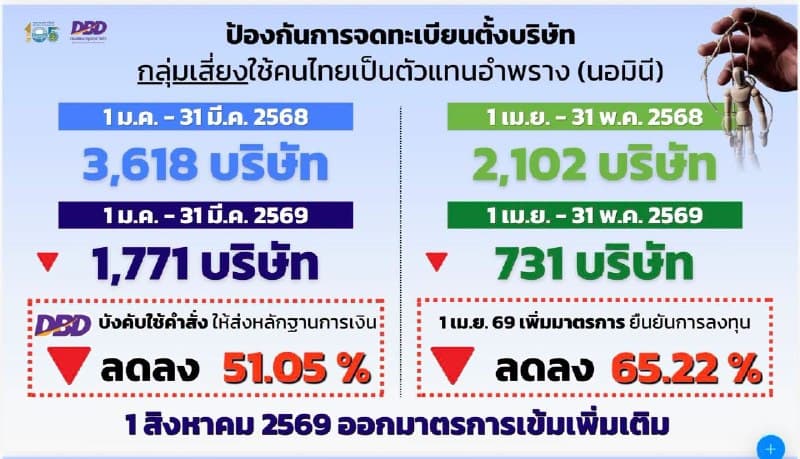
The campaign has shown significant effects through two main phases. Following regulatory orders requiring bank statements, registrations of companies in the risk group fell by over 51% in the first quarter year-on-year. After mandatory investment confirmation began on April 1, new registrations dropped by more than 65% in April and May. From January to May 2026, only 2,502 new risk-group companies registered, half the pace of the previous year.
Authorities have escalated inspections, with the DBD referring thousands of cases to various agencies for deeper investigation. These include tax audits of nearly 15,000 companies, property ownership checks of over 17,500 firms, and focused probes by specialized police units. Inspections have been conducted across 11 provinces including Surat Thani (Samui and Phangan), Phuket, Krabi, Pattaya, and Bangkok, targeting sectors like accounting, legal services, villa ownership, construction, steel trading, tourism, coworking spaces, and coconut processing.
For those living on or visiting Koh Samui, this means an increased government presence in business activities, especially in real estate and service sectors serving foreigners. While the measures aim to enhance transparency and legitimize investments, they also reflect ongoing efforts to regulate the island’s dynamic economy. OG Lab notes that staying informed about local business regulations can be a practical advantage for expats running or engaging with companies here.