Cannabis Tourism: Why Some Nations Buy Freely and Others Won't Even Walk In
The cannabis tourism industry is worth $17B. But while Americans and Europeans freely browse Thai dispensaries, Chinese tourists avoid them like police traps — and South Koreans can be jailed for smoking abroad. The world's craziest cannabis laws explained.
Quick Answer
Cannabis tourism is a $17B industry. Americans, Canadians, Europeans freely buy cannabis abroad. Chinese face testing on return, Koreans can be jailed for smoking abroad (up to 5 years), Japanese face up to 7 years. Singapore has a death penalty from 500g. Dubai: 4 years for 0.003g.
TL;DR | Quick Summary
A World Split in Two
Cannabis tourism is a $17 billion industry, projected to reach $24B by 2030. Half of millennials consider cannabis access when choosing a vacation destination. Thailand has over 7,000 dispensaries. Amsterdam, the 40-year cannabis tourism capital, is stepping aside.
But here's the paradox: while some nations happily walk into dispensaries, others avoid them like minefields. It's not about personal preference — it's about the laws waiting for tourists back home.
Those Who Buy
Americans: "We have the same thing in Colorado"
For citizens from the 24 states where cannabis is legal, walking into a foreign dispensary is like walking into a coffee shop. No stress, no fear. Californians, Coloradans, and Nevadans have been used to legal shops since 2012. Thai dispensaries are just an exotic version of the home experience, often at 5–10x lower prices.
Canadians: calm and systematic
Canada legalized cannabis federally in 2018 — one of the first major countries. For Canadian tourists, a cannabis shop in Bangkok is as normal as Tim Hortons. No legal consequences at home, no stigma.
Europeans: the new wave
Germany legalized cannabis in 2024 (up to 25 grams, up to 3 plants). Spain has long had cannabis clubs in Barcelona and Catalonia. The Dutch are coffeeshop veterans. Malta became the first EU country to legalize recreational cannabis. Europeans are one of the fastest-growing groups of cannabis tourists in Asia.
Australians: far away but enthusiastic
Australia decriminalized cannabis in several territories, and medical cannabis has been legal since 2016. Australian tourists are among the most active buyers at Thai dispensaries.
Those Who Fear
China: "It's a police trap"
Perhaps the most dramatic story. When Thailand legalized cannabis in 2022 and dispensaries opened even in Bangkok's Chinatown, Chinese tourists began avoiding them entirely. Warnings spread on WeChat: "Cannabis shops are police traps!" This isn't a joke — it's a real fear.
And it's not unfounded. The Chinese Embassy in Bangkok officially warned citizens: consuming cannabis in Thailand can lead to criminal prosecution upon return to China. The mechanism is simple and brutal: upon entering China, you may be randomly drug-tested. The test detects substances from the past 3 months. A positive result = a crime, even if you smoked in a country where it's legal.
Consequences:
-
3–15 days administrative detention
-
Fine up to 2,000 yuan
-
For foreigners: deportation + 5-year entry ban
-
For trafficking: up to death penalty
Real case: a Volkswagen executive in China tested positive for cannabis after a trip to Thailand. Result: 10 days detention and expulsion from the country.
South Korea: you can't smoke even abroad
South Korea's 1976 Cannabis Control Act is one of the most extraordinary laws in the world. It applies extraterritorially: Koreans are prohibited from using cannabis anywhere on the planet, even in countries where it's completely legal.
This isn't a formality. The South Korean Embassy in Canada sent notifications after legalization in 2018: "It is illegal for South Korean citizens to use cannabis, even if they are in a region where cannabis is legal."
Penalty: up to 5 years in prison or a fine of up to 50 million won (~$37,000).
For the K-pop industry, cannabis means career death. BIGBANG's T.O.P. was arrested in 2017 for marijuana use — edited out of all TV shows, dismissed from the military. BTOB's Ilhoon faced prosecution in 2020. iKON's former leader received a suspended sentence. Every case is a national scandal.
Japan: 76 years without punishment for smoking — then suddenly...
Until 2024, Japan had an astonishing loophole: possessing cannabis was illegal, but using it was not. Technically you could smoke if the cannabis wasn't yours. On December 12, 2024, the law changed for the first time in 76 years.
Now cannabis use is a criminal offense carrying up to 7 years in prison with no fine alternative. Possession: up to 5 years. Trafficking: up to 10 years.
In March 2025, police made their first arrests in Tokyo: urine tests showed cannabis metabolites. Japanese police have intensified controls in tourist areas popular with visitors from countries with legal cannabis.
Consequences for foreigners:
-
Detention for up to 23 days without charges
-
Limited lawyer access
-
Trial, prison, deportation
-
Lifetime ban on entering Japan
Official position: "Cannabis is neither culture, nor tradition, nor fashion. It is a serious drug offense."
Singapore: death penalty for 500 grams
Singapore is a country where people are executed for cannabis. The mandatory death penalty applies from 500 grams (roughly the size of a bag of flour). In 2024 alone, 4 executions took place for drug trafficking. In 2023, a citizen was executed for transporting just over 1 kg of cannabis.
Possession or use: up to 10 years in prison or a S$20,000 fine. Singaporeans who used drugs abroad face testing upon arrival.
Every international flight to Singapore announces: "Drug trafficking may be punishable by death."
UAE / Dubai: 4 years for a speck of dust
Dubai — a tourist's dream and a smoker's nightmare. A British tourist received 4 years in prison for 0.003 grams of cannabis — a microscopic residue stuck to the sole of his shoe at the airport. Another person was jailed for three poppy seeds from a bread roll bought at Heathrow.
Since 2022, the UAE slightly relaxed rules for first-time offenders at entry (fines of 5,000–20,000 dirhams), but only for minimal amounts at the border. Inside the country — zero tolerance.
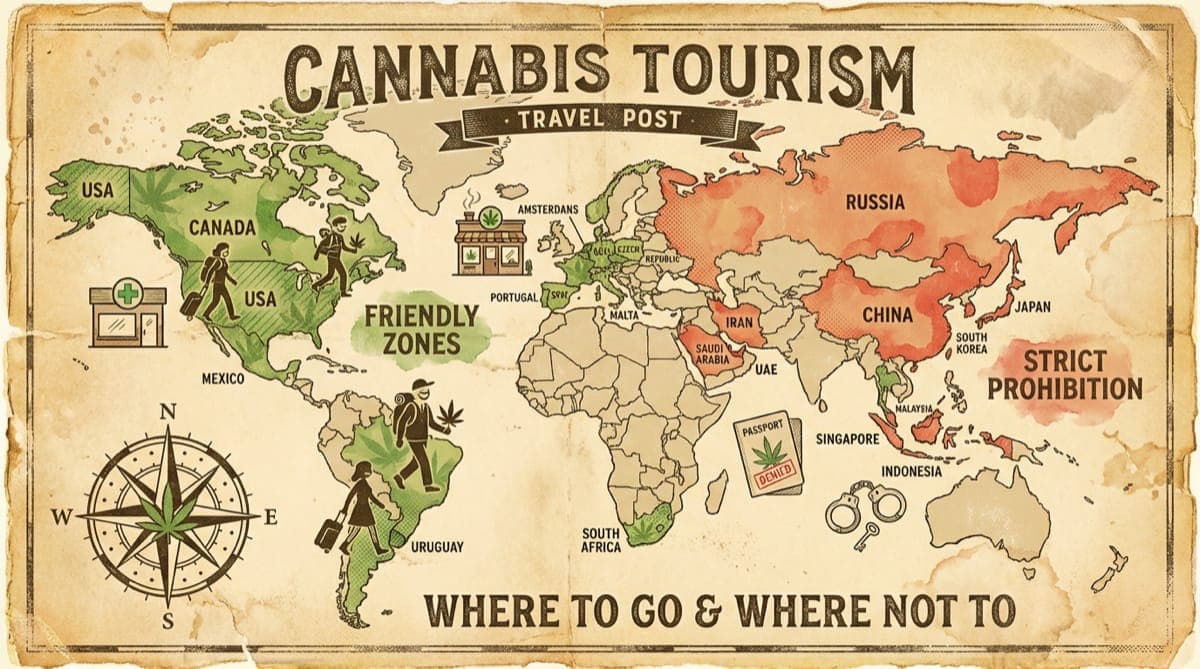
Cannabis Tourism Map: Where You Can and Can't Go
Green Zone (legal or decriminalized for tourists):
-
Thailand (7,000+ dispensaries, though laws may tighten)
-
Canada (full legalization)
-
Uruguay (world's first country to legalize)
-
Netherlands (coffeeshops, but restrictions growing)
-
Spain (cannabis clubs)
-
Germany (since 2024)
-
Malta (since 2021)
-
South Africa (decriminalized)
-
USA (24 states, not federal)
Red Zone (severe penalties up to execution):
-
Singapore (death penalty from 500g)
-
China (testing on entry, detention)
-
South Korea (extraterritorial law, up to 5 years)
-
Japan (up to 7 years, lifetime entry ban)
-
UAE (prison for micro-doses)
-
Indonesia (up to 12 years for possession)
-
Malaysia (severe penalties)
-
Saudi Arabia (flogging and prison)
Why Is the Gap So Enormous?
It's not just about laws — it's about culture. In Western countries, cannabis traveled from 1960s counterculture through medical use to full normalization. In East Asia, drugs are associated with the 19th-century Opium Wars, national humiliation, and societal collapse. Singapore's and Malaysia's harsh anti-drug policies are a legacy of fighting colonial-era opium addiction.
For a Korean or Japanese person, marijuana isn't a "soft drug" — it's a stigma capable of destroying careers and social bonds. For an American from Colorado, it's something sold next door to the coffee shop.
Two worlds. One cannabis.
This article is for informational purposes only. Before traveling, check current laws in your destination country and your country of citizenship.
📚Sources & References
- 1Korea Times: Koreans who smoke overseas face charges
- 2SCMP: China punishes for drugs taken abroad
- 3Japan tightens cannabis controls, arrests first tourists
- 4CNN: Inside Singapore prison that executes for cannabis
- 5Reuters: Dubai frees Briton caught with speck of cannabis
- 6Nation Thailand: China warns nationals against cannabis
- 7National Geographic: Amsterdam bows out, new cannabis tourism capital
- 8AP News: Thailand cannabis tourism boom