Sabai Sabai: A Thai Philosophy of Ease as a Living Culture of Return in the Age of Burnout
Western blogs flatten *sabai sabai* to beach idyll. We unpack reduplication, Theravāda equanimity, the rice year, Rama IX’s sufficiency economy, polyvagal “return” under chronic stress, a Western Snoop-figure, six small practices, Koh Samui, and a lucid look at the smile, hierarchy, and the law. Not moodboard content—researched, sharp, and usable in 2026.
Quick Answer
Sabai-sabai names sustained inner ease while acting—not laziness, not hygge. In Thai, reduplication slows breath. Buddhist equanimity, tropical agrarian pace, and sufficiency economics all point to the same: hold reserve. The article offers six micro-habits and a 2026 self-test, plus honest limits: Thailand’s smile has shadow; import is always partial; *sabai* can slide into passivity in wrong climates and joints.
TL;DR | Quick Summary
On Western blogs and in Instagram “field guides,” sabai sabai has been turned into a tourist souvenir—something like “Thai hygge”: a smile, a hammock, a coconut, turquoise water. In actual Thai life, the word does not behave the way a farang (ฝรั่ง—the usual Thai term for a Westerner) might expect. A country with this kind of cultural grammar, year after year, sits among the world’s top twenty rice exporters, houses Asia’s eighth-largest automotive industry, and hosts roughly thirty million foreign visitors a year: numbers that do not line up with how the idea is often sold from the outside. So the gaze has been in the wrong place.
This article is an attempt to look where it should. Below is a compact editorial research piece: what สบาย สบาย is from the angles of language, Theravāda practice, Thailand’s agrarian past, and King Bhumibol’s sufficiency-based vision; why the fast take that “it is just about laziness” misfires; and how the whole picture connects to contemporary work on the body, stress, burnout, and the architecture of a working day in 2026. The working hypothesis is that sabai sabai is not a mood. It is a living culture of return to yourself, woven into language, the body, and the grain of daily gesture—and that is why it matters on a beach in Koh Samui and behind a laptop in Berlin, Tbilisi, or San Francisco.
1. What the word สบาย really does
Start with the literal. Sabai (สบาย) entered Thai from a Sanskrit line related to sabhāya—“fitting, proper, in good condition”—by way of Old Khmer layers. The Royal Institute Dictionary of Thailand (B.E. 2554/2011) offers three main semantic nests:
-
bodily well-being: healthy, not ill, not run down;
-
psychological ease: calm, not anxious, not on edge;
-
environmental comfort: pleasant, unforced (of a chair, a room, the weather).
So sabai already spans what English scatters across “healthy,” “calm,” and “comfortable.” The detail matters: Thai does not first see a person as a point but as a system in context. When someone asks sabai dee mai? (สบายดีไหม), they are not, strictly, asking for a mood in the modern Western sense. They are asking about the state of that whole system.
Next: reduplication. Sabai sabai is reduplication—a core move in Thai grammar. In English or Russian, repeating a word is a rare literary gesture; in Thai, doubling a word is standard. It can:
-
turn a quality into an ongoing, stretched condition;
-
soften a claim, adding a sense of “roughly, like this”;
-
slow the tempo of speech—saying a word twice means another exhalation.
When a Thai person says sabai sabai, they are not really claiming “I am very comfortable.” They are naming a mode—a sustained, soft, low-drama way of being, for the person or the situation. That is a subtle but decisive shift. Sabai sabai is closer to verbal aspect than to a flat adjective. Not “good,” but “in a good mode right now.”
Notice, too, that the phrase sits in a much larger family of speech, including at least:
-
jai yen (ใจเย็น, a “cool heart”): the skill of not turning up the emotional heat;
-
jai yen yen (ใจเย็น ๆ), the reduplicated, gentle form—“ease the heart a little”;
-
mai pen rai (ไม่เป็นไร, “it’s nothing serious”): a social formula for letting go of small frictions;
-
kreng jai (เกรงใจ, lit. “tender toward another’s heart”): considerateness, a refusal to impose;
-
sanuk (สนุก): pleasure, the sense that if it can’t be done with a spark of sanuk, the point is in question.
Together, these make up part of what anthropologist Niels Mulder, in Inside Thai Society (Silkworm Books), called Thailand’s “social-moral grammar.” Sabai sabai is not a free-standing token in that grammar. It is a gauge for how the whole way of being is running. It is not quite parallel to Danish hygge (a mood of coziness) or Japanese ikigai (a frame for a life’s purpose). Hygge lights a scene; ikigai names a meaning-stack; sabai sabai names how you keep your state in motion while you act.
2. Three historical roots of “ease”
Where did it come from? In short, from three strata that accreted over time.
Theravāda Buddhism and upekkhā
Thailand is among the most thoroughly Buddhist large societies on the planet: the 2020 national census had roughly 93% of the population in the Theravāda fold. At the center of that tradition stands upekkhā (Pali) / upekkhā (Sanskrit) — equanimity, the fourth of the four brahmavihāra (divine abidings) alongside mettā, karuṇā, and muditā. Upekkhā is not indifference. It is the condition in which the mind is not yanked back and forth between “I want it” and “I refuse it,” neither hunting nor shoving away.
The great Thai forest master Ajahn Chah (1918–1992) puts the point in a line that echoes in ordinary speech: If the heart is always grasping and rejecting, you are already tired before you have done a thing (as rendered in the English Food for the Heart). That is ascetically worded dharma, but the same line of force drops from the forest into street-level Thai as jai yen yen and the descriptive sabai sabai. Philosophy in Thailand does not always move by treatise. It often moves by the shape of a sentence you can say while you work.
Tropical agrarian rhythm
The second root is material. Historian David K. Wyatt, in Thailand: A Short History (Yale University Press), is explicit: Siamese civilization took shape on wet rice. Rice needs patience (a field cycle of roughly three to six months) and coordination with a large group (irrigation, transplanting, harvest). Add a tropical lowland: humidity often in the 75–85% range on the central plain, and temperatures over 30°C for much of the year. A long-horizon strategy of “redline and sprint” is not biologically free here. Heat exhaustion and dehydration finish the job long before a spreadsheet deadline.
A rice grower is not “efficient” in the same sense as a Western office idiom. They have to be regular and sustainable. A centuries-long habit of not spending the body in one white-hot burst is wired into a culture of pauses, midday stillness, long family meals, and unhurried markets. Sabai sabai in the field is a direct order: do not flog the pace; keep an even line; you need enough in the tank for the whole run. That is not laziness. It is an energetic discipline—a kind of sufficient tempo in muscle and weather.
King Bhumibol and the “sufficiency economy”
The third root is already modern. On 4 December 1997, five months after the Asian financial crisis (which, remember, began in Bangkok on 2 July with the break of the baht), King Bhumibol Adulyadej (Rama IX) gave a set-piece speech in which he unfolded the idea of sufficiency economy (เศรษฐกิจพอเพียง). The three supports are moderation, reasonableness, and a built-in resilience (the power to take a hit); the two conditions are knowledge and a durable ethic.
In 2006 the United Nations Development Programme folded that philosophy into Thailand’s Human Development Report as a national development stance. The crux: sufficiency is not poverty, not puritan minimalism. It is the formula hold something back. Do not produce at the hard ceiling. Do not spend to the last baht. Do not promise at the last syllable. Do not live on the very edge of the breath. At the everyday speech level, that has a direct linguistic echo in sabai sabai: move with spare capacity in the lungs and in the plan.
Buddhist equanimity gives you an inner layer of sabai; rice and climate give a somatic layer; royal sufficiency language gives a household layer. Three stories, one weave. That is also why the tourist phrase “just relax” misses: relaxation is the absence of action, whereas sabai is a way of acting while staying recoverable.
3. What sabai sabai is not
To keep the research from turning romantic, the fence posts:
It is not laziness. The OECD Employment Outlook (2023) has employed Thais at about 42.3 hours per week—well above Germany (34.6) or the Netherlands (31.0). A villager in Isaan and a 7-Eleven clerk in Bangkok are not short on work. The difference is pace and the inner weather you hold while you move.
It is not the same as mai pen rai. Anglophone travel listicles often fuse the two. But mai pen rai is a social line for letting go of a small annoyance that already happened (“it’s nothing”). Sabai sabai describes the present operating mode of a whole situation. The first is a response; the second, a state. To blur them is like blurring “sorry” and “I slept well.”
It is not hygge and not ikigai. Hygge is a Nordic aesthetic of shared warmth in long winter dark. Ikigai is a Japanese way of situating a life at the overlap of what you love, can do, can be paid for, and the world can use. Sabai sabai does not stage a room and does not name a life purpose. It tunes tempo and the quality of attention inside whatever you are already doing, purpose or not.
It is not a moral stance of “wanting nothing,” either. A serious Thai sabai posture can sit next to a fierce demand for quality: think of a street pad thai cook searing a plate in ninety seconds while the face stays open. The outside speed can be high while the inside stays unclenched. That, perhaps, is the sharpest line: sabai is not externally slow; it is internally quiet.
4. A rereading: sabai sabai as a culture of return
Most writing on sabai sabai flattens to some version of “Thai people teach us not to rush.” A different frame fits better. This is a living culture of return to yourself, worked into language, the everyday gesture, and the social film of a day—a culture that for centuries has trained people not to redline the psyche and, just in time, to come back to a clear, simple “I’m all right inside the task, not only after I finish the task.”
Contemporary work on the body and stress chimes. Stephen Porges, The Polyvagal Theory (Norton, 2011) is one of many ways to name a plain fact. The body shifts between mobilization (geared to strike or flee) and a calmer, socially open readiness—the band where real conversation, attention, and a felt sense of life are possible. The city we built—notifications, endless feeds, one more “small” task at the end of a line—tends to park us in the first half, while almost everything we live for actually lives in the second.
Look how Thai everyday culture leans back the other way.
-
Jai yen yen, said aloud, is a tiny public promise: we can both cool down; let’s not heat each other for nothing. Small gesture, large leverage.
-
Reduplication (sabai sabai, jai yen yen, cham cham — “easy-easy, slow-slow”) literally leans on the breath. To say a two-beat word twice is to buy another full exhale—and the exhale is the body’s own off-switch.
-
Kreng jai bakes in a habit: do not, without need, shove the other into tension. No surprise calls, no jabbing for an instant decision, no shouting past someone’s composure. In human terms, treat the other’s warmth the way you treat your own.
-
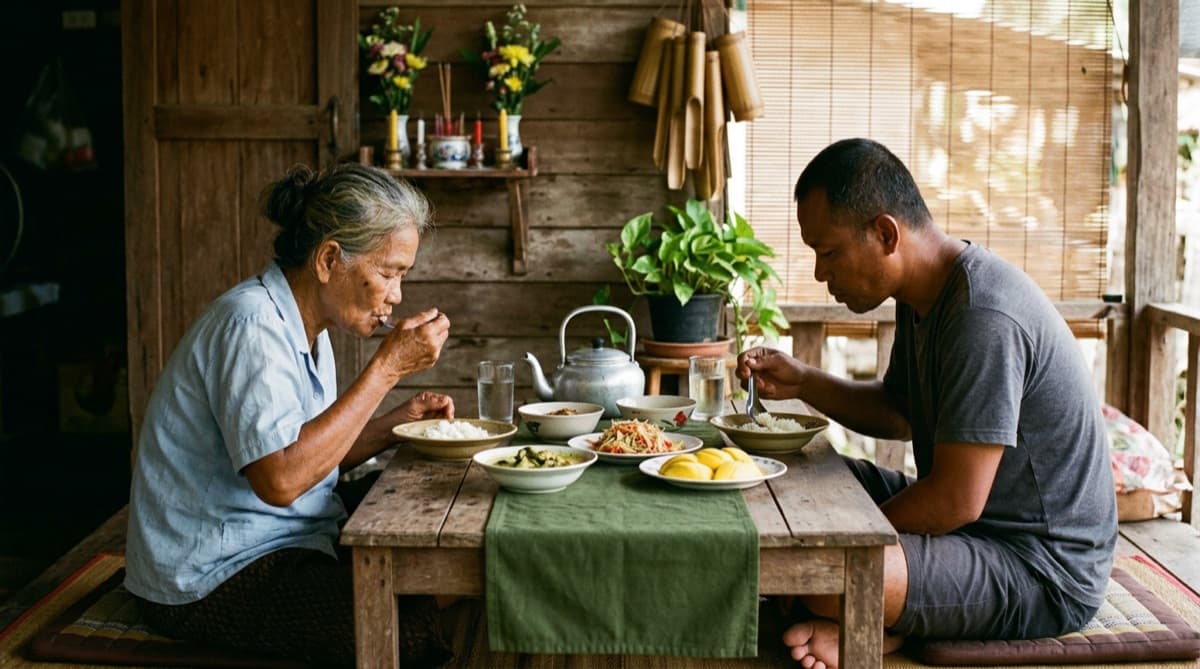
Long, unforced meals (the kin khao [“eat rice”] style, often forty to sixty minutes with others), an after-lunch hush, the wai of palms together—all are small places where a day re-grounds itself.
The net: Thai public culture has rehearsed, for a very long time, days threaded with short returns to a person’s own ease—in food, in speech, in the gaps between one encounter and the next, in the ritual shapes of hello and goodbye. It does not romance the all-night siege. It spreads load so you do not fall into permanent “do-do-do” or the grey shrug of not caring. That is not a philosophy of “work less.” It is the skill of staying you inside the work, longer.
This is the fault line in modern city life. In May 2019 the WHO classified burnout as an “occupational phenomenon” in the ICD-11—a chronic stress pattern people could not metabolize. “Could not” is the hinge: that is not a moral failure; it is a lost everyday habit of returning warmth. Many Thais inherit that habit. A lot of us, somewhere between the Industrial Revolution and the phone in the pocket, dropped it.
5. Why this is for capacity, not against it
A fair reader will ask: fine—but when do I actually work? The false opposition has to go. In Stanford’s Kelly McGonigal, The Upside of Stress (Avery, 2015), a large data story runs like this. What shaves years is not the presence of high demand by itself, but the conviction that stress is destroying you, plus the lack of any rhythm for coming back. People under heavy load with repair loops in the week often outlive, and outwork, people under lighter load with a static hum of worry.
Sabai sabai does the same in motion: it does not necessarily lower how much is on the plate. It lowers the static anxiety around the serving. And so:
-
decision quality rises (a mind in alarm is a narrow mind);
-
the “cost per hour” of the workday drops (less of the expensive stress fuel is burned in circles);
-
taste survives—why you said yes in the first place.
At the level of national metaphor, the sufficiency economy and sabai sabai say the same: hold reserve. Reserve in a plan. In a conversation. In a day. In respect for a body. Reserve is not indulgence. It is what long honest work is built from. If you want to be not only effective but able to feel the work while you do it, reserve is not optional. A life does not pack into a mind running at 100% duty cycle and stay vivid.
In that light Thai ease is not a rival to productivity. It is the missing rim on the wheel.
6. A Western paradox: Snoop Dogg, accidental sabai master
The most surprising illustration did not come from Thailand but from Long Beach, California. Calvin Cordozar Broadus—Snoop Dogg, whom we have profiled in a separate long read—has, across thirty-plus years, racked on the order of two dozen Grammy nominations and as many studio albums, built a cluster of large businesses (Death Row Records, which he re-acquired in 2022; Merry Jane; the Leafs By Snoop cannabis line), spent serious years on the Snoop Youth Football League, co-authored a cookbook with Martha Stewart, and commentated the Paris 2024 Olympics, after which NBC reported a sharp lift in young-adult viewership. That is mid-cap corporate output. In frame, though—voice color, tempo, pause, the half-lidded gaze, the slow smile—you see a living portrait of sabai sabai.
Snoop is not a Thai Buddhist, not a forest monk. He did not study the lexicon. He groped the same posture through the California hood and three decades in a high-decibel music industry: a lot to do in the world, a quiet floor inside the house. The public chill is not a pose. It is a working inner tone—and that, more than “hours in the studio with the engineer,” is what lets him still be Snoop in a fourth career decade when many of his age cohort bailed or burned. For our purposes he is a Western gloss on jai yen yen: a cool heart on a hot set. The lesson is the line itself: the inside tempo need not be run by the outside one. The beat is replicable.
7. Six small practices: weaving a personal sabai into a day
Research with no use-case is just prose. Below are six micro-practices drawn from everything above. We have lived with them long enough to speak; we do not claim the list is exhaustive. Think of it as a floor, not a ceiling.
1. Slow start (the “slow morning”)
Keep the first thirty to forty-five minutes after waking in sabai sabai: no headlines, no inbox, no snap decisions. In village Thai this is the kin khao chao (breakfast) interval—time for rice before the world. It is a window in which a mind finishes leaving the night and sets the tone of the day. That tone, once it locks in, tends to run the day. Opening the morning from a calm register is cheaper than fighting back into calm all afternoon.
2. Jai yen yen — a breath before the response
A two-breath gap between stimulus and action: in a talk, a thread, a high-stakes choice. Trivially easy: one inhale, one slower exhale, jai yen yen said silently, then answer. Enough for the next word to come from the clear, not the hot. On a rough week that alone saves a friendship or two and a pair of impulsive messages.
3. Reduplication out loud
Say a few of the day’s true intentions, slowly, in doubled, soft little beats—“steady-steady… easy-easy…” (Use whatever pairings feel honest in your mouth. The Thai logic still holds: two small exhales, back to back, are not a mantra. They are breath mechanics.) It helps on a three-hour call, before a big room, in traffic. With children, it propagates: they will pick it up before you are done explaining.
4. The sanuk first pass
Before a heavy block, a single line of inquiry: where is the sanuk here—the light hook, the one place your consent can get purchase? The bar is not “Everything must be fun” (that is a child’s bargain). The bar is “There must be at least one true yes inside the yes.” If you cannot find that yes, the task is more expensive than its sticker price; budget time, money, or say no. That line rhymes with our long essay on “local worlds of meaning” and which games are worth a life: not every arena deserves your one wild hour.
5. Kreng jai as a work rule
Do not blow through someone’s time and inner state without a signal. In a firm: async by default, windows for real-time, respect for deep work. In a life: do not cold-call, do not demand an instant answer, and do not turn your urgency into their emergency. Someone else’s nervous system is not your buffer. The habit is wildly under-billed in distributed teams.
6. At least one slow shared meal a day
The social anchor. If you can, with people you choose, phones down, thirty to forty-five minutes, not a gas-station feed but a kin khao meal, sitting. A long shared table is the most reliable return a day can hold: chew, swallow, talk, laugh, look at each other. One of those, most days, weighs in felt life about as much as a serious training block does, because it sustains a warmth you cannot, alone, keep lit.
All six are small. This is not “move to Thailand and you will be happy.” It is a sketch of a day if you take seriously the thought that stillness is not the absence of action, but a manner of action.
8. Caveats
Research should not go soft. Three honest footnotes.
First, sabai in public is not a sealed message to the private you: a public smile is often a role in contact, and a steady timbre is both an honest read of the nervous system and a convention—layers mingle. Mai pen rai about a trifle and a sabai of the body and its pace share a verbal form; a broad ease can drown a tighter grip on a genuine grievance. In practice, keep warm self-regulation (breath, honest contact with the flesh) separate from numb nods to a hazy “it’s all fine”. A quick self-check: in the flesh, is it genuinely lighter, or did attention go quiet?
Second, cultural import is always partial. You will not re-import temple time, a rice year, and an extended-family floor plan by making breakfast gentler. You get a sliver. But, as the Scandinavian, Japanese, and kaizen cases show, a sliver, lived in good faith, can beat a full pose.
Third, ease has a somatic price. In wet tropical heat, not flogging the pace is how you stay alive in the field. In a long northern winter, on a diet of takeout and work travel, the same idea can tip into passivity if you are not watchful. Sabai is not permission to freeze; it is permission to set your own cadence while you still move.
9. Koh Samui, in the frame of this talk
A word from the place we write. Koh Samui, in the Gulf of Thailand, has for decades been sold as a beach; more recently, it is also a place to think about a certain tempo—not only a postcard. The island’s real story—coconut longtails, a place that until living memory had no proper ring road, a runway a local doctor once bet his savings on, a sabai-paced reinvention of a tourism economy without a catastrophic lurch—we trace in Koh Samui: from fishers, coconut boats, and The White Lotus to the present. A lot of what the cameras hunt for is precisely what a slower history left intact.
After Thailand’s 2022 partial decriminalization of cannabis, a new stratum of cafés, small dispensaries, and clinics appeared—some loud, some not. A slice of that layer cares less about brute lift at any price and more about a pace at which a mind can still taste a day: a contemporary gloss on the sabai question—not to get out of life, but to get the room to match the attention you still own.
At OG Lab, Koh Samui we see a steady pattern: the guests who get the most from a cannabis encounter in our context rarely optimize for the loudest night. They favor balance in cultivars and ritual that leave enough margin for a dinner and a night’s sleep—the same vector as in a “new sobriety”: low THC, set & setting, a culture of enough. In that light sabai sabai is not a license to binge. It is a taste for a modest dose and a higher signal-to-noise ratio in the evening. Thai consumption culture has, for a long time, not been “more is better.” It is “enough to come back to sabai,” and that frame has a wider classroom than the choice of a single strain.
10. A last question, meant seriously
If you close this article and change nothing, nothing will change; that is how cultural protocols work. But you can run one test today—it takes about five minutes.
Think back to yesterday—not the task list, but the state of the day. What share of it did you live in a sabai register—in the sense we have unpacked: easy breath, a margin of attention, the sense that life is happening now and not after you clear the last tab? Ten percent? Thirty? Seventy?
Then, honestly: which one of the six practices above could you thread into tomorrow—not as a new burden, but as a small edit to a route you already run? One practice, not six—one, and keep it a week.
The sabai sabai story alone will not make you a wiser person, if that is the word. It does offer a working hypothesis, easy to test in 2026. Perhaps the tank that is empty by Wednesday is less often a tank of time or a tank of self-control than a deficit of return, a habit of coming back to yourself, a habit dropped where a textile mill gave way to a glowing block of silica.
Perhaps a civilization that for eight hundred summers has lived in tropical heat and a Buddhist way of speaking has compressed that return into a simple doubling of a two-beat word, one you even have to breathe out to say as it should be said.
Then the prize is not the highest sustained throttle, nor to whoever redlines the longest. The prize is to whoever can return to sabai on the line they still hold, before the line gives on its own.
Cultural and informational content; references to cannabis are in the context of the legal environment in the Kingdom of Thailand. Responsible use and compliance with local law are on you.
📚Sources & References
- 1Sufficiency economy — King Bhumibol Adulyadej, speech of 4 Dec 1997
- 2Polyvagal Theory — Stephen Porges (Norton, 2011)
- 3WHO: Burn-out an occupational phenomenon, ICD-11 (28 May 2019)
- 4Ajahn Chah — Theravada forest tradition teacher
- 5David K. Wyatt, Thailand: A Short History (Yale University Press)
- 6Niels Mulder, Inside Thai Society (Silkworm Books)
- 7Kelly McGonigal, The Upside of Stress (Avery, 2015)
- 8Cannabis in Thailand — partial decriminalization, June 2022