The White Lotus on Koh Samui: How One HBO Show Sent Searches for the Island Up 88%
Mike White's third season of The White Lotus premiered on HBO on Feb 16, 2025, filmed at Four Seasons Resort Koh Samui. By May, searches for Samui were up 88%, bookings up 44%, nightly rates up 10–50%. OG Lab breaks down the show, the making of it, the Samui locations, the Thai cast with Lisa of BLACKPINK, Sam Rockwell's viral monologue, the pong-pong tree plot device — and why we're saying a clear thank-you to Mike White and HBO for picking our island out of all of Thailand.
Quick Answer
HBO's The White Lotus Season 3 (Feb–Apr 2025) was filmed at Four Seasons Resort Koh Samui by Mike White. After the premiere, searches for Samui jumped 88%, hotel bookings 44%, and average nightly rates 10–50%, per Bangkok Post, CNBC, and The New York Times.
TL;DR | Quick Summary
Every once in a while, culture quietly shifts the arrows on the tourism map. On February 16, 2025, HBO premiered the first episode of the third season of The White Lotus — and by May of the same year, search queries for Ko Samui had jumped 88%, hotel bookings were up 44%, and the average nightly rate had climbed 10–50%, per Bangkok Post and CNBC. The Vice President of the Tourism Authority of Thailand publicly suggested that for the first time in the island's history, Samui may not have a low season.
We live and work on this island, and we watched the show quietly rewrite the way the world talks about Samui. This piece is for people who haven't caught the show yet; for those who want to understand how it's put together; for anyone curious about why Mike White picked the Four Seasons in Laem Yai Bay; which specific Samui locations made it into the frame; and how we at OG Lab think about this new layer in the island's story. Short version: with gratitude, and without drama.
What The White Lotus is: a quick primer if you haven't seen it
The White Lotus is an HBO anthology created, written and directed by Mike White. Each season is a self-contained story set at one property in a fictional luxury hotel chain called "The White Lotus." Guests check in for a week, we watch them through a magnifying glass, and by the finale someone is almost always dead — but the show isn't really about a murder. It's about how rich people meet themselves on vacation. And about what the locals, who have seen this theater play out over and over, quietly make of it.
-
Season 1 (2021): Maui, Hawaii. Four Seasons Resort Maui at Wailea. Won Outstanding Limited Series at the Emmys and nine other statuettes.
-
Season 2 (2022): Taormina, Sicily. Four Seasons San Domenico Palace.
-
Season 3 (2025): Ko Samui, Thailand. Four Seasons Resort Koh Samui on Laem Yai Cape.
All 8 episodes of Season 3 were written and directed by Mike White himself — a rarity in American prime-time television, where big writers' rooms have long been standard. The finale aired on April 6, 2025. The show is distributed on HBO and Max.
White's signature is unhurried, sunset-wind conversations in which the polite mask peels off layer by layer; close-ups on smiles that hold half a beat longer than they should; and satire that never turns into a pamphlet. He respects his characters just enough to let them look alive — and just enough not to let them hide.
Why Thailand, and why specifically Samui
Each season, White picks a resort setting where two civilizational logics collide — "guests" and "hosts." In Hawaii it was the postcolonial context. In Sicily, North American pragmatism ran into Southern Italian memory. For Season 3, White needed a context in which spirituality and hospitality are not decor but a living part of daily life. Thailand was a natural fit: a country where more than 90% of the population practices Theravada Buddhism (2020 national census), and where the luxury-hotel grammar itself is built around the idea of sabai-sabai — a slow, lingering comfort we've written about at length elsewhere.
Within Thailand, Samui wasn't an accidental choice. In an interview with Condé Nast Traveler, White named three reasons:
-
The enclosed, "island" feel of the location: large enough to host a six-month production, small enough to create the sense of a cage — a crucial element for a claustrophobic drama;
-
A preserved everyday texture — fishing villages, temples, family-run restaurants — half an hour from the ultra-luxury bubble;
-
The Four Seasons Resort Koh Samui itself on Laem Yai Cape, opened in 2007: 60 private pool villas on a steep slope down to the Gulf of Thailand, with nightly rates Homes To Love described as "$4,000 a night".
We've told the island's own story — from Hainanese coconut plantations and bamboo fishing boats to a modern airport built on the personal initiative of a local doctor — in a separate long-read: "The history of Koh Samui: from fishermen and coconut plantations to The White Lotus". Without that context, the "White Lotus effect" looks like a sudden flash; with it, it reads as the logical next step on a path the island has been walking for fifty years.
Which Samui locations made it into the show
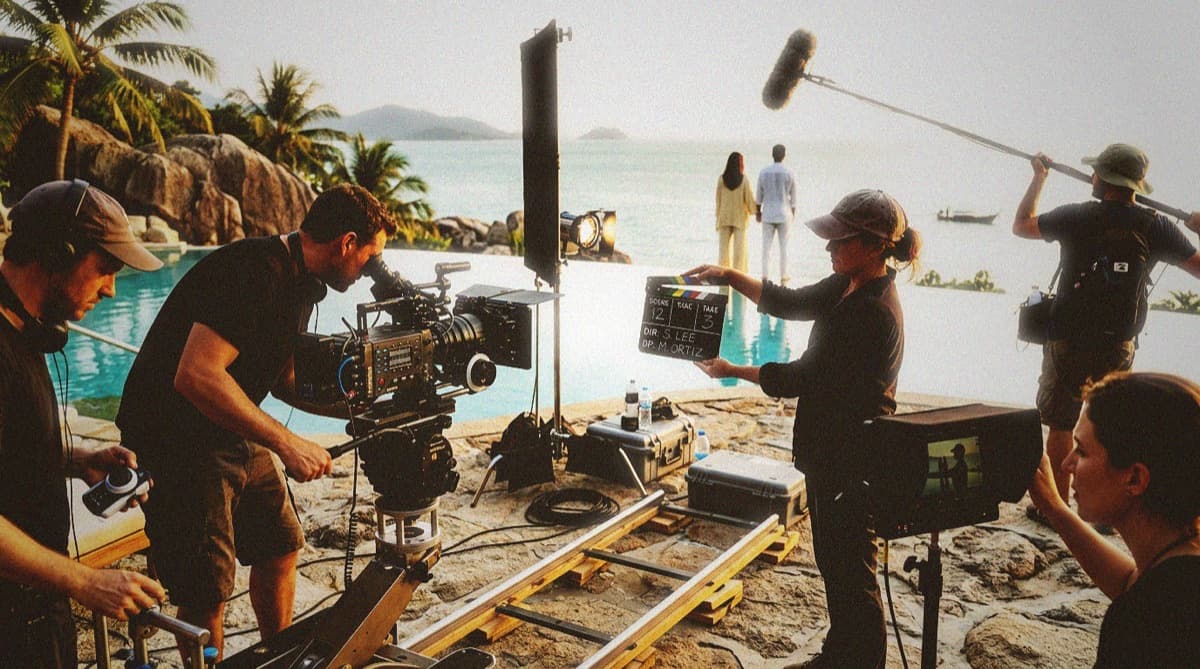
Filming for Season 3 ran in Thailand for about six months — from February through August 2024. The main base was the Four Seasons Koh Samui; everything you see on screen as "the White Lotus hotel" was shot there. But the production worked actively with the surrounding island and neighboring locations, too.
On Samui:
-
Four Seasons Resort Koh Samui (Laem Yai, northwest coast) — the main stage, lobby, restaurants, pool villas, beach club.
-
Anantara Bophut Koh Samui Resort — some waterside and restaurant scenes.
-
Fisherman's Village (Bophut) — the old fishing village with wooden storefronts that stands in for "real Thailand" when characters step out of the resort.
-
Wat Phu Khao Thong and other Buddhist temples — episodes where the season's Buddhist thread comes to the surface.
-
Choeng Mon Beach — a handful of beach scenes.
On Ko Phangan and in Ang Thong Marine Park:
-
Ang Thong Marine Park (Mu Ko Ang Thong) — the 42-island archipelago northwest of Samui, where the characters take a boat tour.
-
Atmospheric references to the Full Moon Party on Ko Phangan — not reproduced literally, but present as a recognizable night-beach sketch.
Elsewhere in Thailand:
-
Anantara Mai Khao Phuket Villas — some interior scenes that edit together as "White Lotus Samui" were actually shot here.
-
Mandarin Oriental Bangkok — for Bangkok set pieces.
Worth naming: what the viewer sees as a single "White Lotus island" is, in reality, a composite. That's standard practice on a prime-time production at this scale. But the underlying visual pulse that runs through the whole season — the turquoise Gulf of Thailand, the granite boulders on Laem Yai beach, the morning mist over the palms — that really is Samui.
Who's in it: a stacked bench and a Thai debut
The Season 3 cast is a blend of American indie prestige, the English drama school, and — especially important for our island — Thai actors in substantive roles.
The guests of the fictional "The White Lotus":
-
Parker Posey as Victoria Ratliff — a dehydrated Southern matriarch with a bottomless supply of lorazepam; her monologues became the most-quoted clips of the season's first half.
-
Jason Isaacs as Timothy Ratliff, a financier whose money — and faith in himself — evaporates at the start of the vacation.
-
Walton Goggins as Rick, a brooding American who clearly didn't come to Thailand for the massages.
-
Aimee Lou Wood as Chelsea, a young Englishwoman traveling with Rick.
-
Carrie Coon, Leslie Bibb and Michelle Monaghan — three childhood friends on the kind of "girls' trip" where every skeleton falls out of the closet in one cocktail.
-
Patrick Schwarzenegger and Sam Nivola as the two grown Ratliff sons, whose storylines become, arguably, the most unexpected thread of the season.
-
Sam Rockwell — in a one-scene cameo that broke the internet.
-
Natasha Rothwell — Belinda, returning from Season 1, the only recurring character across the anthology.
On the Thai side:
-
Lalisa Manobal (Lisa of BLACKPINK) — the global K-pop star's acting debut, as resort staffer Mook. For Thai audiences this was a cultural moment in its own right: Lisa is a Buriram native, and this is her return home on screen.
-
Tayme Thapthimthong — a Thai actor playing a hotel security officer; one of the very few characters in the show who actually sees what is going on rather than just reacting to it.
-
Lek Patravadi — a veteran of Thai stage and screen, playing the abbess of the temple.
-
Dom Hetrakul and several other Thai supporting actors.
The proportion — Thai actors carrying real plot subjectivity, not placed as "local color" — is a clear step forward from Seasons 1 and 2. We think it was the ethically right call from Mike White.
How it got made: three behind-the-scenes stories
The feud over the theme music. The show's signature — the anxious, shamanic main-titles melody — is the work of Chilean-Canadian composer Cristóbal Tapia de Veer. He wrote the themes for all three seasons (including Season 1's "Aloha!", which won the Emmy for Outstanding Original Main Title Theme Music in 2022). After the Season 3 premiere, a public disagreement broke out. In interviews with the New York Times and BBC, Tapia de Veer said Mike White refused to release an extended cut of the theme with the "ooh-loo-loo-loo" vocal hook that fans had embraced. White countered that the composer "had a hard time taking notes." The outcome: Tapia de Veer has confirmed he will not return for Season 4. Whatever Season 4 ends up sounding like, the sonic DNA that carried that tropical-trance feeling in the titles is probably going with him.
Walton Goggins was actually bitten by a snake. In several interviews, Goggins said a snake bit him during one of the night shoots in the Samui bush — a nine-hour shift. He was fine, but the detail is a reminder that this production wasn't living on a soundstage. It was living in real jungle, with every risk that came built in.
One man, the whole script. All 8 episodes of Season 3 were written solely by Mike White. For American prime-time at this budget level, that is extremely unusual: series of this scale usually have writers' rooms of six to ten people. White was the sole writer and sole director of every episode. You can hear it: the season breathes as a single continuous breath, without the telltale seams between episodes written by different hands.
The scene the planet was talking about: Sam Rockwell's monologue
If Season 3 has one scene that by itself justifies watching the whole thing, it's Episode 5: a bar in Bangkok, two men at a table — Rick (Walton Goggins) and his old friend Frank (Sam Rockwell). Frank came to Thailand once and stayed. Rick drops by to ask a favor on a murky piece of business. Instead of a business chat, Frank delivers roughly a six-minute monologue of a kind American television hadn't seen in a long time.
No spoilers: it's a speech about years of obsession, about Thailand as a mirror of one's own desire, about trying to stop being yourself — and about how a man ends up at Buddhism through the most unexpected door. Rockwell plays it so you physically cannot look away. But the remarkable thing isn't what Frank says — it's how Rick listens. Goggins's silent, brick-white face, with his slowly widening eyes, went viral as a meme under the hashtag "Rick listens," and American acting schools have already started citing the scene as a textbook example of reactive acting: the character says nothing, but it is his silence that drives the scene.
This is one of those scenes that justify the whole idea of prestige television. You want to watch it twice: once listening to Frank, once looking only at Rick.
The suicide tree: Thai botany as the heart of the plot
This section touches on finale elements. You may want to return to it after you've watched the show.
Another detail that turns Season 3 into a rare example of narrative discipline is the pong-pong tree (Cerbera odollam), known in the English-language botanical literature as the suicide tree. It's a real South Asian plant, common across Kerala and southern India, and — crucial for our island — quietly grown as an ornamental in Thai resort gardens, including on Samui. Its seed contains the cardiac glycoside cerberin, which blocks heart-muscle function; in Indian toxicology studies, Cerbera odollam was long responsible for thousands of fatal poisonings a year. A mild bitterness is easily masked by sweetness, which is precisely why — according to historical records — the seeds were used in South Asian "witch trials" in the 18th and 19th centuries: survive and you were innocent, die and you were guilty.
Mike White turns this tree into the heart of the finale's plot mechanics. Timothy Ratliff (Jason Isaacs), a financier teetering on the edge of ruin and prison, learns about the pong-pong's properties from a hotel worker. He gathers the seeds, pulps them in a blender, mixes them into piña coladas — ready to feed them to his whole family so "no one has to live in a new world where they have no money." At the last moment, he backs out and pours the drinks down the sink. But the blender goes unwashed. Classic Chekhov's gun: a blender shown in Act I will fire by Act III. His son Lochlan later makes a protein shake in that same blender — and drinks it with residual traces of the poison. The New York Times took the toxicology apart in its own piece: everything in the scene is realistic, right down to the symptomatology.
The visual idea here is brilliant. The pong-pong tree is native to Southeast Asia. It decorates the guest garden of the fictional White Lotus the way orchids and frangipani do. Which means an absolute, centuries-known poison is standing two meters from the sun loungers and the mango-smoothie pool. That is the season's central thought about a tourist's relationship with place: around you lives a whole ecosystem you don't see, because you came here to relax; and inside that invisible ecosystem live both your peace and your risk. On Samui this isn't a metaphor — pong-pong really does grow in dozens of private gardens as just another ornamental tropical species. The locals know. The guests don't.
The "White Lotus effect" on Samui: what actually happened after the premiere
The numbers should be stated cleanly, without exaggeration. Sources: Bangkok Post, CNBC and The New York Times, all published in February–March 2025.
-
Search queries for Ko Samui: up 88% year over year (Tourism Authority of Thailand and travel aggregators).
-
Hotel bookings on the island: up 44%.
-
Average nightly rate: up 10–50%, depending on category and season.
-
Searches from the United States: up 65% since January 2025, per Agoda.
-
Overall Samui hotel searches on Agoda started climbing a few weeks before the premiere — by 12%, meaning the trailer and announcement were already doing work.
-
Thailand overall: the country was targeting 40 million international tourists in 2025, and the Tourism Authority publicly named Samui one of the main growth points.
Four Seasons Resort Koh Samui closed the season essentially booked out for months, according to local hoteliers. On the knock-on effect, Anantara Bophut, Centara Grand Beach Resort Samui, boutiques in Bophut Fisherman's Village, tour operators to Ang Thong Marine Park — and what we, as locals, especially appreciate, the small independent cafés, massage parlors and yoga studios in Chaweng, Lamai and Bophut — all caught the lift.
The mirror the tourist is looking into
Worth noting: Mike White is not making a tourism promo. His Season 3 is, quite often, an uncomfortable mirror for the Western viewer who flies to Asia "for the spirituality." The big through-line of the season is about characters trying to buy peace: through retreat, massage, meditation, temple, sex, money. And again and again the season gently shows one thing: peace is not for sale. It can only be had the way Thailand built it for itself over eight hundred years — through its own culture of returning to sabai, through jai yen yen, through stopping.
The irony is that this anti-tourist framing is exactly what turned the season into a tourism magnet. Viewers saw a Thailand that wasn't flattering them, and for that reason they believed it. The more honest the screen, the stronger the urge to check it in person. This is one of those rare cases where good drama outperformed any advertising budget.
And a related paradox: the show also features a real cannabis lounge, Magical Weed Garden Lounge on Samui — included as part of the resort landscape after Thailand's partial decriminalization of cannabis in June 2022. The White Lotus chose not to turn that into shock content: in White's frame, the cannabis lounge is simply one more room on the property, like the spa or the beach club. That choice, too, works to de-exoticize the island and quietly normalize what contemporary Samui actually looks like for a global audience.
Thank you for choosing our island
We at OG Lab on Ko Samui are a small, local business. We watched Season 3 in two modes at once: as viewers, like everyone else, with popcorn and a next-day episode chat; and as locals, understanding that every shot of Four Seasons at 9 p.m. in New York is turning into dozens of bookings at 9 a.m. in Bangkok. And that is good news for the island.
Thank you to Mike White and HBO for picking Samui. This is a quiet, very slow place that changed over a hundred years, and then for another hundred and fifty always looked about to be caught by the world — and the world kept not quite catching up. You gave the island a soft nudge. Not an ad, but a piece of art — an important difference. You weren't trying to sell the island. You were trying to see it, and in doing so you accidentally sold it.
Thank you to the cast, who stayed on the island for months, walked respectfully through villages and temples, and didn't treat the place as a backdrop without consent. Thank you to the Thai cast — Lisa, Tayme, Lek and the rest — for bringing dignity into the frame, not ethnographic set dressing.
Thank you to Four Seasons, Anantara and everyone who let the production into their rooms. That is a hard call to make — giving up half your hotel for six months to a TV crew — and it paid off for the whole island, not just for you.
And specifically — thank you for picking Samui, and not another island. Thailand is big. Phuket, Phangan, Krabi, Lanta were all realistic options. You chose this particular spot, and beyond the economic lift, that choice gave Samui a cultural status it didn't have before: the island now has its own face in global drama. Bali has had that for decades. Sicily has. Hawaii has. We finally do too.
If you haven't watched yet — where to start
A short, practical bit. If you want to get into The White Lotus from scratch, here's a spoiler-free route.
- Don't start with Season 3. Each season stands alone, but Season 1 (Maui) gives you the key to how White works with structure: a week at a resort, a death in the first scene, then flashback. Without that frame, Season 3 can look merely slow.
- Watch with subtitles, not dubbed. Half the show is intonation. Parker Posey's voice as Victoria is untranslatable; you have to hear it in the original.
- Don't expect a whodunit. This isn't "who killed whom." It's "why did everyone arrive at a place where someone had to die." Watching it as a thriller is the fastest way to be disappointed.
- Be ready for the slow pace of the first two episodes of Season 3. White deliberately spends time letting you live in the hotel with the characters before the masks start coming off. Be patient. It pays.
- Don't close the window right after the finale. Season 3 doesn't end on a climax; it ends on aftertaste. And inside that aftertaste is where the main thing actually happens: you start looking at your own life through what you just watched.
Where to watch legally: HBO in the US, Max in regions where the service is available, and a number of local streaming platforms licensed by Warner Bros. Discovery.
We live inside this wave
The "White Lotus effect" isn't a new story for the island; it's just a new layer on an old one. Samui has been absorbing waves for decades: the 1970s backpackers (Samui is where the word bong crossed into global English — we go deep on that in our big history piece on the island); the premium resorts of the 2000s; the 2022 cannabis renaissance; and now HBO in 2025. Each wave left something behind. One left roads and an airport, another left coffee and yoga culture, another an entire street-food industry.
The White Lotus wave leaves one thing the island had not quite had before: a global language in which Samui can now be discussed outside guidebooks. When someone writes the book on the tropical vacation as a modern phenomenon in 2026, this season will be in it. That means the island has stopped being "just a resort" and has become a cultural address — and at that address, its real superpower is still running: sabai-sabai, the slow pace, a place where you can breathe.
Tourism-growth figures reflect the state of things as of spring–summer 2025, based on reporting in Bangkok Post, CNBC and The New York Times.
📚Sources & References
- 1Bangkok Post — The White Lotus sparks tourism boom in Koh Samui
- 2Bangkok Post — Koh Samui enjoying a White Lotus boom
- 3CNBC — Where is The White Lotus filmed? Koh Samui searches and prices surge
- 4The New York Times — New Season of The White Lotus Brings a Tourism Boom in Thailand
- 5Condé Nast Traveler — The White Lotus Season Three: All the Thailand Hotels and Locations
- 6Travel + Leisure Asia — Thailand Through The White Lotus Lens: Season 3 Filming Locations
- 7HBO — The White Lotus (official)
- 8Four Seasons Resort Koh Samui (official)
- 9Wikipedia — Mike White (filmmaker)
- 10Wikipedia — Lisa (rapper, BLACKPINK)
- 11Wikipedia — Cannabis in Thailand (partial decriminalization, June 2022)
- 12Homes To Love — Tour The $4000/night White Lotus Season 3 Filming Location
- 13The New York Times — White Lotus Theme Song Composer Won't Return for Season 4
- 14BBC — The White Lotus: Creator Mike White hits back at composer Cristóbal Tapia de Veer
- 15Mashable — The White Lotus Season 3: Sam Rockwell's monologue is already a meme
- 16The New York Times — The White Lotus Pong-Pong Tree Fruit Really Is That Dangerous
- 17Wikipedia — Cristóbal Tapia de Veer
- 18Wikipedia — Cerbera odollam (suicide tree)
- 19Wikipedia — Sam Rockwell
- 20Wikipedia — Walton Goggins